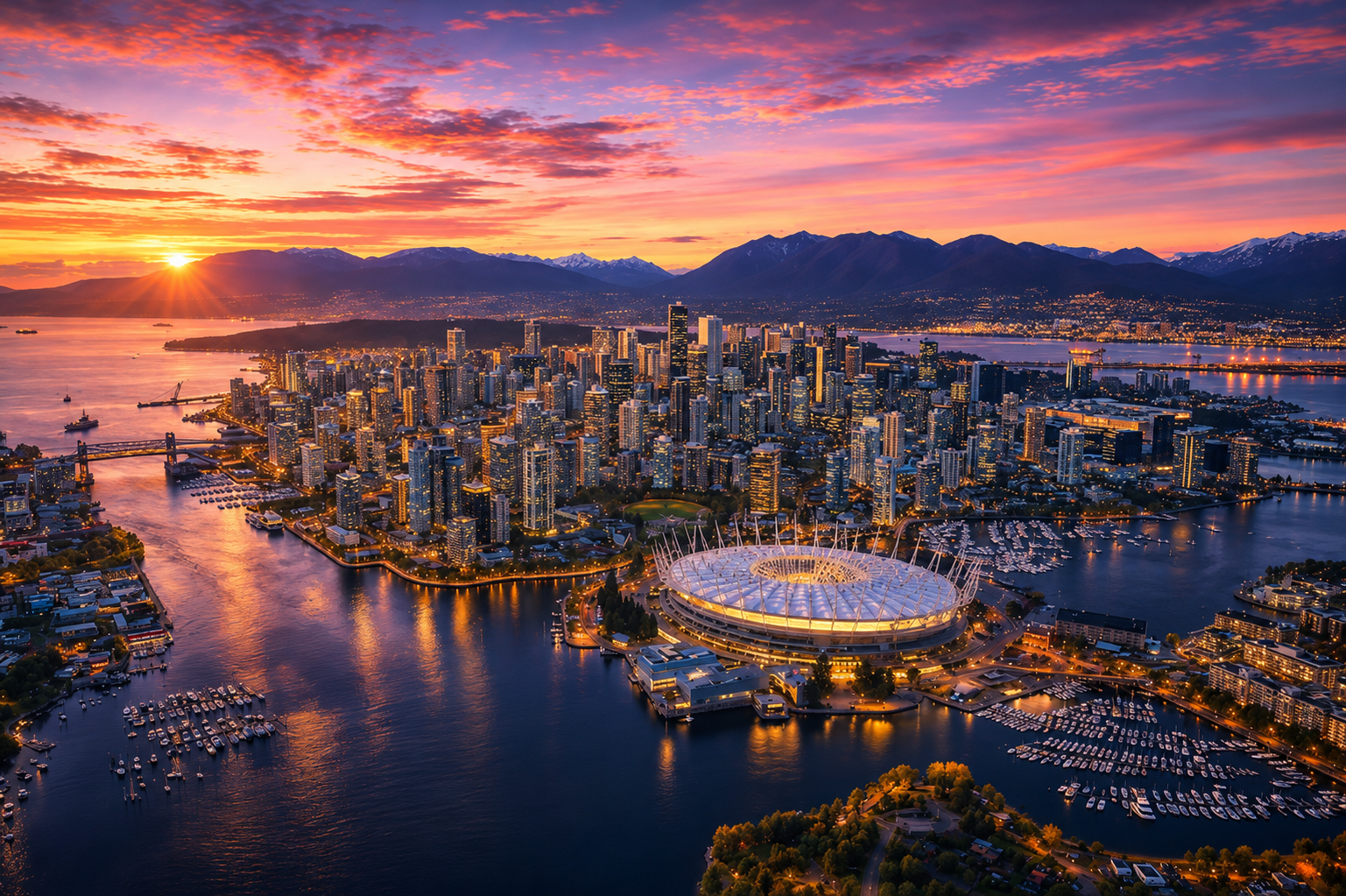
Hey there! I’m that travel blogger whose eyes light up the second anyone mentions Vancouver — the one who starts mapping out friends’ itineraries before I’ve even packed my own bags ✈️ And with Vancouver being one of the 2026 World Cup host cities, the whole city has seen a wave of changes to its transit, neighbourhoods, and park management!
In this post, I’m dumping out my entire Vancouver “pocket list” from all the trips I’ve taken over the years, then layering in the latest local regulations, the newly increased 2026 TransLink fares, historical deep-dives, and proper fact-checking. I’ve reorganized it all into one complete guide you can use whether you’ve got 24 hours downtown or a full five-day, four-night trip.
Honestly, there are tons of Vancouver articles floating around online, but I’ve noticed a lot of them contradict each other — or are just plain wrong (for the Nine O’Clock Gun in Stanley Park alone, I came across three different casting dates before digging through the official historical archives to confirm it was 1816 😅). So this time I made a point of verifying every key figure, correcting what needed correcting and adding what needed adding — all so that once you’ve read this, you can bookmark this single post as your entire pre-trip handbook.
If you’re planning a Vancouver trip and want to wrap your head around how to actually do Stanley Park, Granville Island, the Gastown Steam Clock, English Bay, and the Waterfront — how to play it, what it costs, how long to stay, plus the must-eat food and must-buy souvenirs — then pour yourself a coffee and follow along ☕
Table of Contents
🌲 Stanley Park: An Old-Growth Forest Right Next to the City (2026 Ecological Restoration Underway)
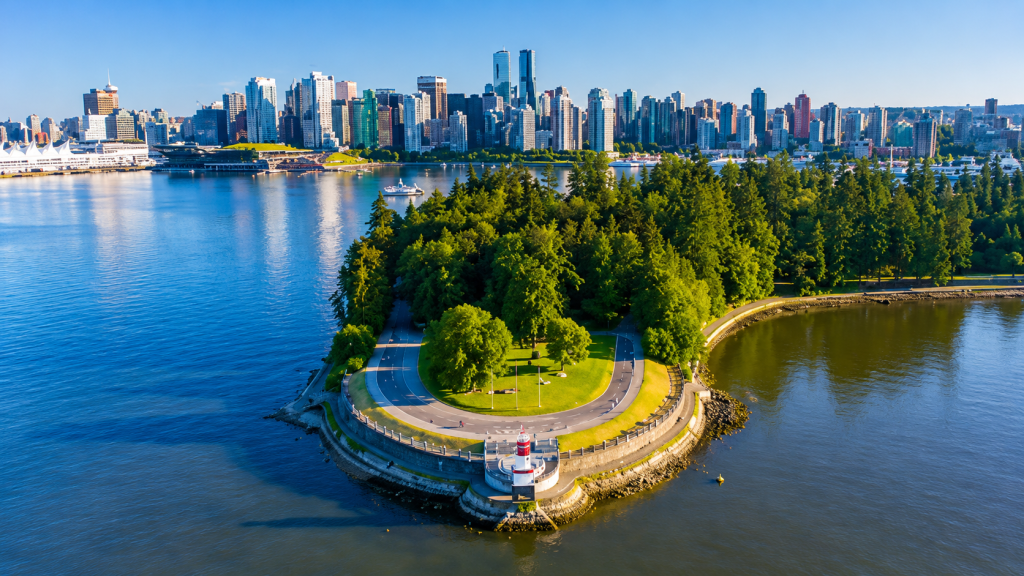
I’ll be real with you — the first time I stood at the entrance to Stanley Park, my jaw just dropped. This isn’t a “park” the way I’d always pictured one. It’s an entire living, breathing old-growth temperate rainforest sitting right on the edge of the city.
📊 Why Stanley Park Absolutely Has to Be on Your Vancouver List
Here are a few numbers that honestly blew me away:
| Item | The Numbers |
|---|---|
| Size | Officially around 400 hectares (about 1,000 acres) |
| Number of trees | Once around half a million; after the Western Hemlock Looper infestation crisis of 2019–2023, by 2026 the third phase had removed roughly 14,000 dead and hazardous trees and replanted over 75,000 native saplings, while some giants still tower up to 76 metres tall and are hundreds of years old |
| Seawall (around the park) | About 9 km (5.6 miles) |
| Interior forest trails | Roughly 27 km total (2026 heads-up: with the third phase of hazardous-tree removal ongoing, some interior trails like Lees Trail and Lovers Walk may be intermittently closed at certain times — always check official notices) |
| Annual visitors | Up to 18 million a year |
| Hours / Admission | Daily from 6:00 a.m. to 10:00 p.m., free entry (some facilities charge separately; bylaws prohibit staying overnight and parking vehicles overnight) |
It’s about 20% bigger than New York’s Central Park, and it’s one of the largest and oldest urban parks in North America. But here’s the most special part — unlike Central Park, which was artificially “designed,” Stanley Park is basically a native forest that evolved naturally over hundreds of years and was preserved intact within the city. That alone makes it worth a dedicated trip in my books.
💡 Pre-trip heads-up: The park itself is free, but if you drive in you’ll pay for parking (run by EasyPark — in the 2026 summer peak season it starts at roughly $4.75 CAD per hour; I’d recommend downloading the app to pay, and always check the official site for current rates and times). If you’re cycling around the park, the bike lane is one-way and counterclockwise only. And if you rent a Mobi shared e-bike, the system automatically caps your speed at 25 km/h inside the park — this one’s super important, and I’ll keep hammering it home below.
🚲 First Things First: Rent a Bike on Denman Street
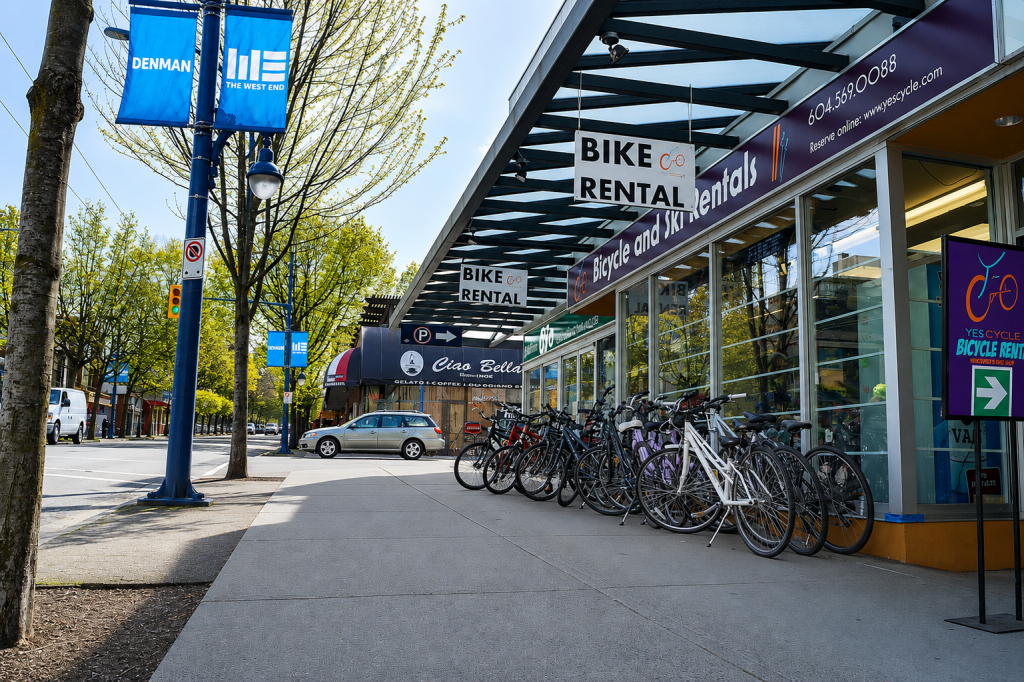
Personally, I can’t recommend this enough — if you’ve only got half a day to a day, renting a bike to ride the Seawall is the best bang for your buck. Walking the roughly 9 km loop takes about 2 to 3 hours, but on a bike it’s just 1 to 2 hours, and you can still stop along the way to take photos, grab a bite, and just zone out staring at the ocean. One thing to watch though: the Seawall bike lane runs one-way, counterclockwise, so whatever you do, don’t ride against traffic!
Where do you rent?
Almost all the rental shops are clustered along Denman Street, near the park’s Georgia Street entrance — an easy walk from downtown. There are at least 5 or 6 bike rental shops lined up one after another on this street (places like Spokes, Bikes and Blades, Freedom Bikes, Yes Cycle, and so on). Prices are pretty similar across the board, so it’s worth a quick comparison before you commit.
How’s the pricing? (The ranges below are rough numbers from my actual 2026 visits — each shop varies a little)
- Hourly rate: a standard city bike runs about CAD $8.50–$13 / hour
- 3-hour (or half-day) package: a standard bike is around CAD $25 — fantastic value
- Full day: about CAD $35–50
- E-bike / electric scooter: pricier — e-bikes are about CAD $17–20 / hour, and electric scooters start around CAD $15 / hour
There’s plenty of choice when it comes to bike type: standard city bikes, mountain bikes, cruisers, tandem bikes (a total winner for couples or besties — though not every shop rents them anymore, so if you’re after one, try asking English Bay Bike Rentals), and even e-bikes and electric scooters. Most shops already include a helmet, a lock, and a map in the rental price.
🛑 3 Things to Check Before You Rent (So You Don’t Get Burned):
- Confirm what’s “included”: most reputable shops now list the helmet and lock as standard freebies. If a shop tries to charge extra for either of those two items, that’s basically a red flag — I’d just walk to the next one. Either way, always ask before you pay.
- Helmets are mandatory: BC law requires you to wear a helmet while cycling, and if a police officer catches you without one, you’re looking at roughly a CAD $29 ticket — they won’t cut you any slack. Also worth noting: if you rent an electric scooter, the rider must be at least 16, can’t ride on regular sidewalks, and breaking the rules can cost up to CAD $109. Don’t risk it.
- Always lock your bike properly: you’ll inevitably want to hop off to take photos, use the washroom, or grab something. Make sure you actually use the lock the shop gives you — leaving an unlocked bike on the side of the road will have you too anxious to enjoy yourself.
💡 Pro tip: Vancouver has a local bike-share system called Mobi, and in recent years it’s actually added 6 stations in and around Stanley Park — so the old “there are no stations inside the park” claim is outdated. That said, I’d still strongly suggest visitors just rent from the shops on Denman Street. Mobi charges by the minute (around $0.29 per minute), which is a terrible deal for tourists who tend to ride for 2 to 3 hours and stop constantly for photos — one casual loop and your bill blows past $50. On top of that, in peak season the park’s docks are often full, so you keep getting charged because you can’t return the bike, and the stress of hunting for an open dock will wreck that relaxed vacation feeling completely.
🚴 Riding the Seawall: The Classic Loop Around the Park
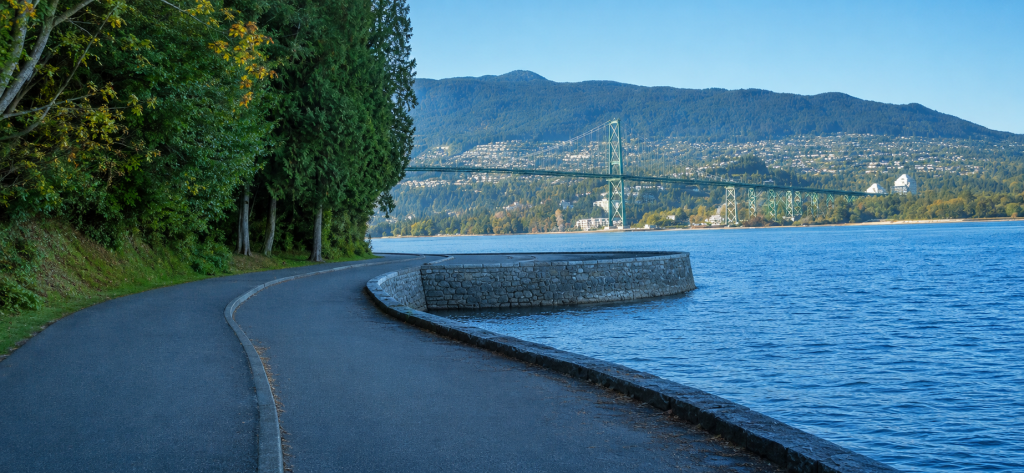
The Seawall is the icon of all Vancouver icons. It’s part of the world’s longest uninterrupted waterfront greenway (the full Seawall wrapping around Vancouver is roughly 28 km), and the stretch circling Stanley Park is about 9 km — the absolute highlight of the whole thing. With the ocean on one side and forest on the other, you can take in the Vancouver skyline, the snow-capped North Shore mountains, and the cruise ships and seaplanes drifting by all at once. The view is so good it almost doesn’t feel real.
Which way do you go?
After entering the park from the Denman Street entrance, follow the Seawall and ride counterclockwise for the full loop. Why does it have to be counterclockwise? Because the bike lane is one-way — going against it isn’t just dangerous, you’ll also get side-eyed by locals into the next century 😂
The path is split into two separate lanes:
- The ocean side (outer lane): for walkers and joggers
- The inner lane: for bikes, rollerbladers, and compliant e-bikes and e-scooters
Please make sure you ride on the correct side and keep right, leaving the left open so faster riders behind you can pass — otherwise you’ll get a non-stop chorus of bells. One more important thing: the legal speed limit along the entire Seawall is 15 km/h, so please slow right down at busy bottlenecks.
🆕 Latest 2026 rules: Good news — the Seawall is now fully and legally open to e-bikes! That said, your bike (or your rental) has to meet BC’s requirements — it needs physical pedals, a motor rated under 500W, and a top assisted speed no higher than 32 km/h to ride licence-free. Another pitfall to flag: the mandatory dismount-and-walk “maze gates” at spots like Lumberman’s Arch, Prospect Point, and Third Beach. The city has approved a plan to remove them and replace them with routing that’s friendlier to people with disabilities, hand-cycles, and trailers — but construction has been pushed to 2027. So if you’re visiting in 2026, those gates are all still there; if you’re towing a trailer or riding a hand-cycle, budget some extra time and take care getting through those bottlenecks.
Stops Along the Way, In Order (Counterclockwise)
Here’s the order I’ve found involves the least backtracking:
- Downtown skyline viewpoint (you’ll see it right as you enter the park — perfect for a warm-up photo)
- Totem Poles
- Brockton Point Lighthouse
- Nine O’Clock Gun
- Girl in a Wetsuit statue
- Lions Gate Bridge (you’ll pass right underneath it)
- Prospect Point lookout
- Hollow Tree
- Siwash Rock
- Third Beach → Second Beach → English Bay
The full loop, photo stops included, takes about 2.5 to 3 hours on a regular bike — a comfortable, unrushed pace. If you’ve rented an e-bike, those headwind stretches feel way easier and you can wrap the whole thing up in roughly 1.5 to 2 hours.
📸 An In-Depth Look at Stanley Park’s Top 10 Must-Visit Spots
1️⃣ Totem Poles: A Living Lesson in Indigenous Culture
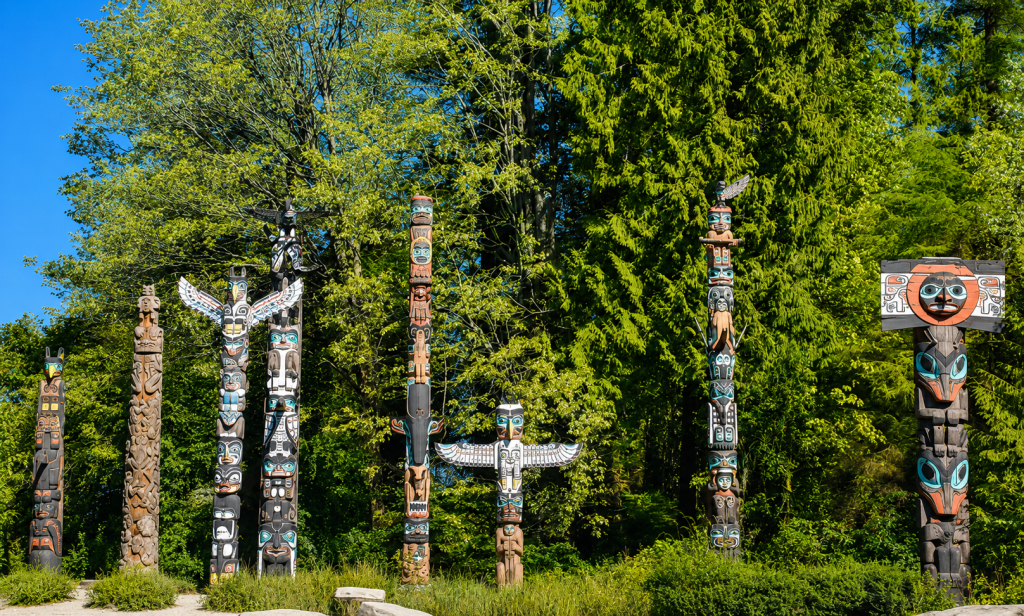
Tucked away near Brockton Point, this cluster of totem poles is one of the most popular photo spots in all of BC — and it’s a stop I never skip whenever I bring friends along.
All 8 poles here were hand-carved by First Nations artists (from nations like the Squamish and Musqueam). Each one tells a story — about ancestors, family lineage, legends, and the natural world. Look closely and you’ll spot different animal figures carved into the wood, like eagles, bears, and whales. (Quick note: one of the more famous poles, “Kakaso’las,” carved by the female artist Ellen Neel, was returned to the UBC Museum of Anthropology for permanent safekeeping back in 2024 — so there are 8 poles on site now. Don’t go hunting for it and come up empty.)
Each pole has an English info plaque next to it explaining the story behind it, so I’d suggest taking 15–20 minutes to slowly read through them. It’s way more interesting than you’d expect.
🎁 Bonus tip: There’s a gift shop right beside the poles (now called “At the Totem Poles Gift Shop“), and it’s full of unique finds — Indigenous-inspired jewellery, bookmarks, magnets, keychains, pendant necklaces, mini totem pole models, and even temporary tattoos. They make great souvenirs for family and friends back home. There’s also a washroom and a visitor centre right next door where you can grab a map and ask questions.
2️⃣ Brockton Point Lighthouse
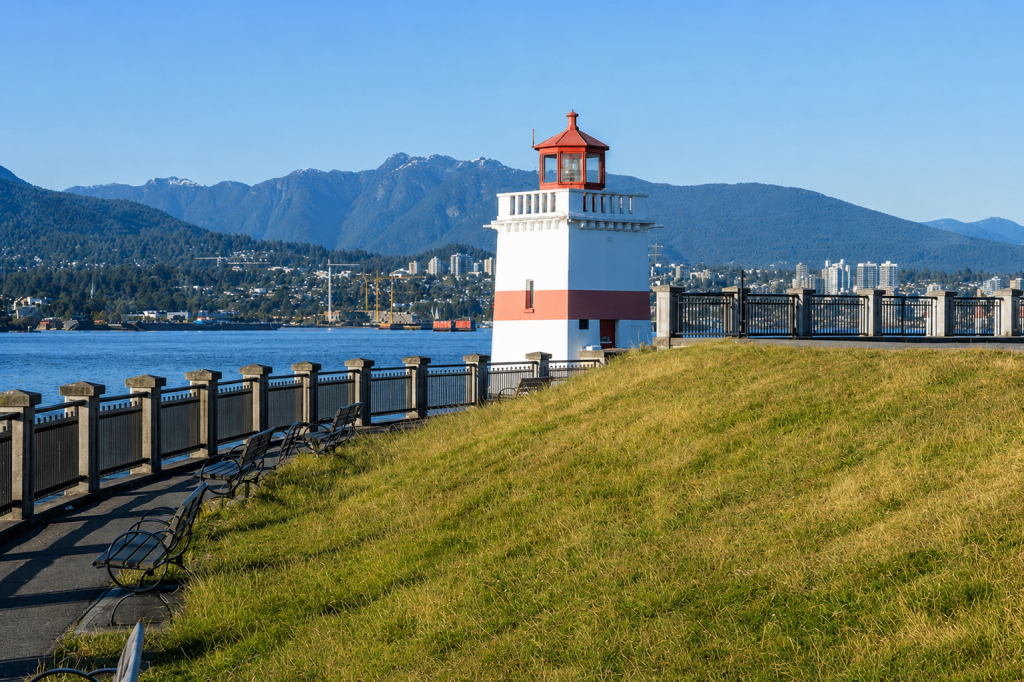
Keep cycling a little further and you’ll come across this small white lighthouse with a red top. The Brockton Point Lighthouse dates all the way back to the late 1800s, and it once had the job of guiding ships in and out of Burrard Inlet. It was officially decommissioned in 2005, and today it lives on purely as a historic landmark and a great photo stop.
From here you get an unobstructed view of the full downtown Vancouver skyline, plus the Canadian flag waving in the wind (a view that feels about as Canadian as it gets). If you’re lucky, you might even catch a cruise ship or a massive container vessel gliding past — this is one of the main shipping channels into the Port of Vancouver. Honestly, you could sit here and watch the boats roll by for a whole hour and not feel like you wasted a minute.
3️⃣ Nine O’Clock Gun: A Vancouver Tradition That’s Been Booming for Over 120 Years
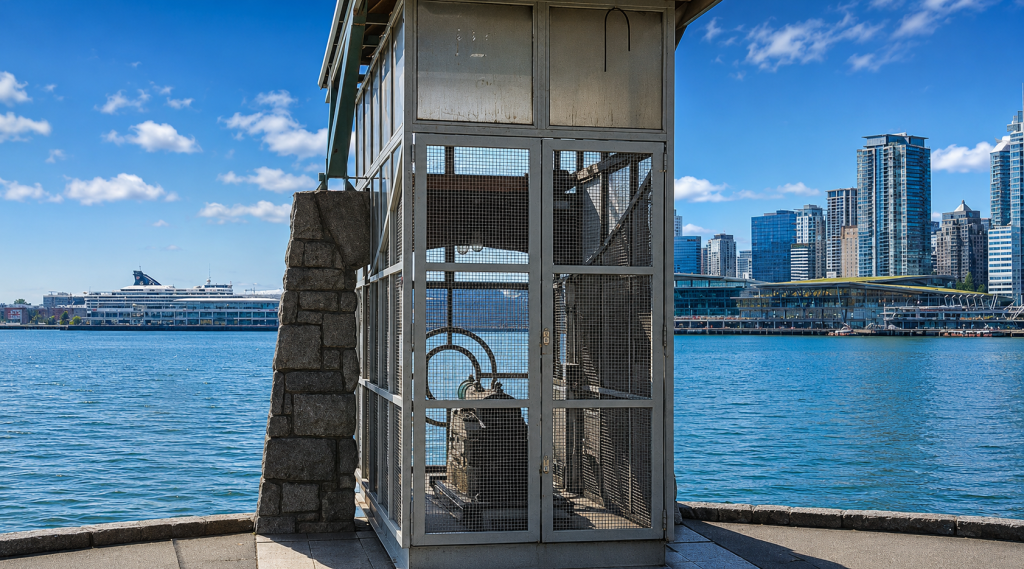
This is one of my favourite spots to tell friends about, because the story behind it is genuinely great.
This 12-pounder muzzle-loaded naval cannon was cast back in 1816 at the Royal Arsenal in Woolwich, England — decades before Canada was even a country. Lean in close and you can still find the personal cipher of King George III on the barrel to this day. It was shipped over to Stanley Park around 1894 and started firing in the park in October 1898.
📌 A quick fact-check: Some articles online claim the cannon was cast in “1864” — that’s wrong. It was actually cast in 1816, arrived around 1894, and fired its first shot in 1898.
Originally, its purpose was to let fishermen know that the Sunday 6 PM salmon fishing closure had begun and it was time to pack it in. Later on, it was switched to firing every night at 9 PM sharp, so ships in the harbour could set their clocks and calibrate their marine chronometers. Even with today’s precise timekeeping, this cannon has stubbornly kept up the tradition, booming every night at 9 PM on the dot. One heads-up, though: in recent years a global black powder supply shortage — combined with strict federal regulations on powder storage — left the cannon seriously short on its specialized gunpowder, forcing it to pause firing on more than one occasion. So if you’ve really got your heart set on hearing it, it’s worth checking ahead to see whether it’s currently firing. Even so, this tradition — booming from the late 19th century right up to today, over 120 years strong — remains one of Vancouver’s oldest and most iconic pieces of city history.
A few things to know if you want to go see (hear?) it:
- Firing time: Every night at 9:00 PM sharp (occasionally paused in recent years due to powder shortages, so it’s best to check the official site or local news before heading out)
- Location: Right along the Coal Harbour seawall path, near Brockton Point
- The cannon now sits inside a sturdy glass enclosure (because back in 1964 some troublemaker tossed a rock down the barrel, and when the gun fired, it actually launched the rock straight into the sign of the Texaco floating gas station parked in the bay… yes, that really happened 😱)
- There’s a flashing red light nearby that warns people the gun is about to go off
- I’d recommend getting there 5–10 minutes early to grab a spot with a good view
That “BOOM” is seriously impressive. It even had its own social media account, @the9oclockgun, which used to automatically post “BOOM!” on Twitter (now X) every night right on schedule — pretty adorable. Sadly, the account stopped updating back in 2020, so these days it’s a little piece of Vancouver nostalgia 😂
🎓 Fun fact: This cannon has had its share of drama too. In 1969, UBC engineering students pulled off a prank and “kidnapped” it — they not only swapped in a fake cannon, but boldly mailed a ransom note to the Mayor of Vancouver, demanding a donation to the children’s hospital before they’d return it. In the end, generous locals and students pooled together nearly $400 for the hospital, and the cannon was safely returned (a mischievous deed turned into a good one — gotta love it). The gun has only fallen silent a handful of times: during the WWII blackout, powder shortages, and mechanical maintenance. Early in the COVID pandemic, it was even temporarily moved to a 7 PM firing to honour frontline healthcare workers — a tradition with a lot of heart.
4️⃣ Girl in a Wetsuit Statue
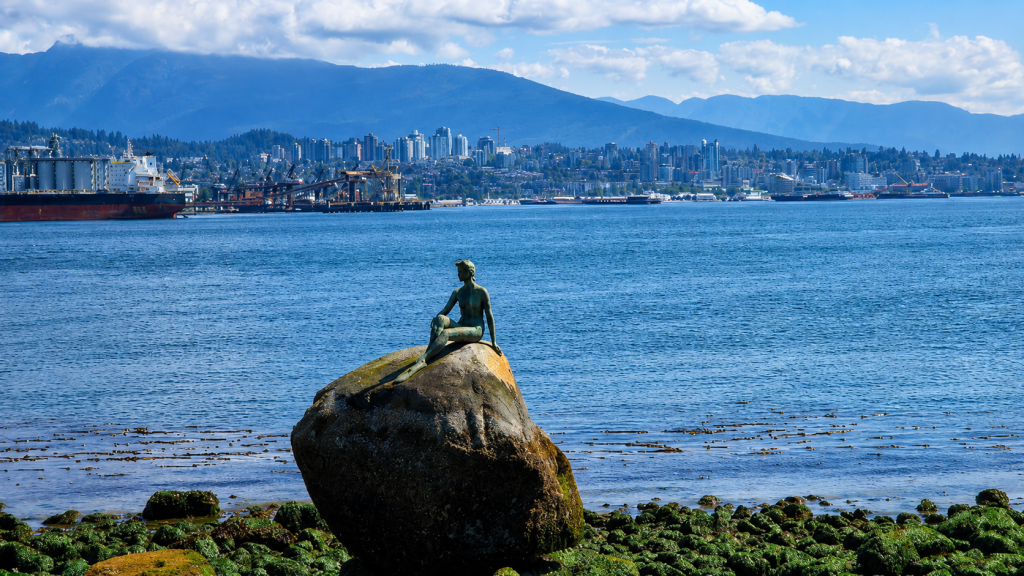
Keep cycling along the seawall and you’ll spot a bronze statue perched on a rock by the water — a woman in a wetsuit and dive mask, gazing gracefully out into the distance.
This statue was completed in 1972 by Hungarian-Canadian sculptor Elek Imredy. A lot of people describe it as “Copenhagen’s Little Mermaid’s sister” — and in fact, the original client really did want a Vancouver version of the Little Mermaid. But Imredy was firmly against copying it; he felt the Little Mermaid was a one-of-a-kind symbol that belonged to Denmark. As it happened, he’d noticed that scuba diving was taking off in Vancouver at the time, so he insisted on reworking the piece into this girl in a wetsuit instead — a tribute to Vancouverites’ love of the ocean and their deep connection to the sea.
📸 Photo tip: At high tide you’ll only see the statue itself, with the rock almost completely swallowed by the water; at low tide the whole rock is exposed and the shot looks dramatically different. (Fun fact: to keep her from being fully submerged at high tide, the engineering team actually brought in a marine crane and shifted this giant rock forward by about 30 metres, setting it on a pre-cast concrete base.) Funnily enough, the amount of the statue poking above the surface is the most intuitive way to tell whether the Port of Vancouver is at high or low tide. If you’ve got the time, check the day’s tide table and pick whichever moment you prefer.
5️⃣ Lions Gate Bridge & Prospect Point Lookout
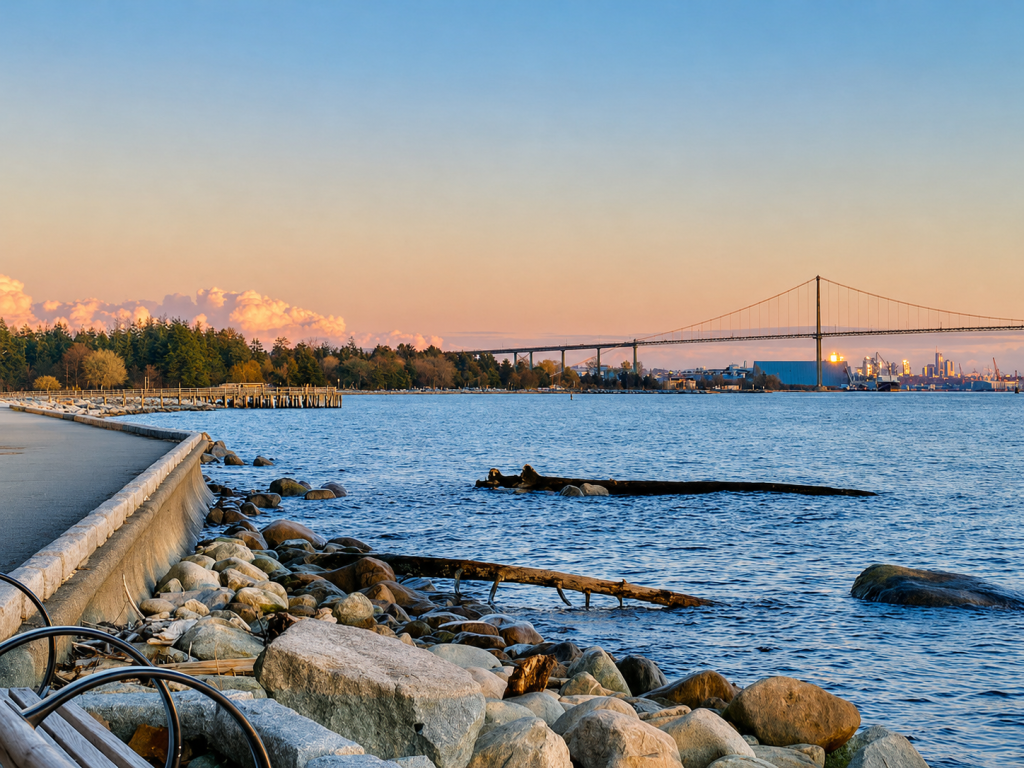
Continuing on, you’ll pass right underneath the Lions Gate Bridge, and the best spot to take in the whole bridge is Prospect Point — the highest point in the park.
From up at the lookout, you can take in the entire Lions Gate Bridge, the North Shore Mountains across the water, and West Vancouver all in one sweep — the view is absolutely maxed out.
🎓 The Lions Gate Bridge’s secret: This green steel suspension bridge, completed in 1938, runs about 1,823 metres long and spans the First Narrows of Burrard Inlet, connecting downtown Vancouver to the North Shore. Here’s the kicker — it was actually built with over five million dollars in funding from the famous Irish Guinness brewing family! Their goal was to boost the value of the huge tract of suburban real estate they’d bought in West Vancouver (the British Properties, sprawling across 4,700 acres). The bridge takes its name from the pair of lion-shaped peaks in the North Shore Mountains (The Lions). At the south end of the bridge, two Art Deco–style lion statues stand guard, created by sculptor Charles Marega — and here’s the interesting part: they’re actually made of concrete, not stone. Apparently Marega was strapped for budget at the time and reluctantly gave up on stone carving in favour of concrete.
The signature view restaurant that used to sit next to Prospect Point has permanently closed, but the attached café (Prospect Point Cafe) and the ice cream stand are still going, open daily in summer from roughly 10:00 AM to 6:00 PM (always double-check the latest hours on the official site). You can still sit down with a locally roasted coffee or grab a sandwich, paired with the full sweep of the Lions Gate Bridge and forest-meets-ocean scenery — it really makes you not want to leave. There’s also a paid parking lot here managed by EasyPark (Lot 62), so if you’re driving, you can start your loop from this point and tour the park in reverse. As of summer 2026, the rate is around $3.75/hour CAD, dropping to about $2.75/hour CAD in winter (please confirm current rates on the official site).
6️⃣ Hollow Tree: A Century-Old Photo-Op Classic
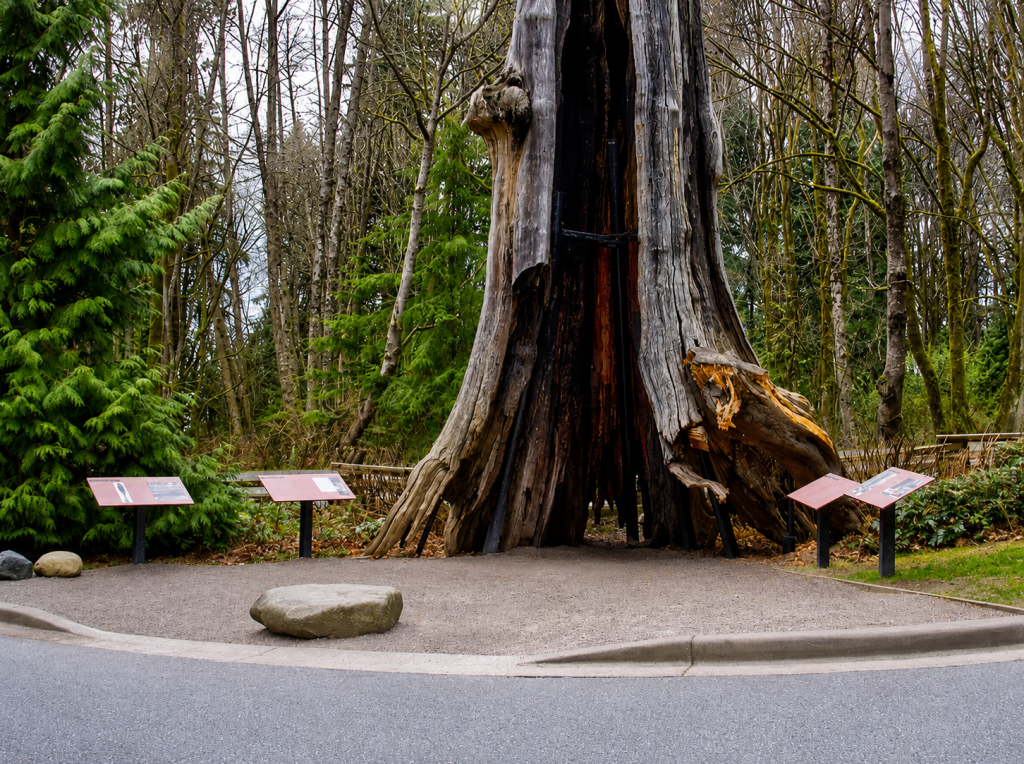
This tree is quite the character 🌳
It’s a hollow Western Red Cedar, said to be roughly 600–800 years old. The upper half of the trunk is long gone due to natural decay, but the bottom half — with that enormous hollow cavity — is still standing right where it always was, and it’s big enough for several people to step inside at once.
From the early 20th century right up to today, that hollow has been one of Vancouver’s go-to photo landmarks. For well over a hundred years, countless visitors (in the early days, people reportedly even drove cars — and supposedly an elephant — into it) have posed for photos in front of the same hollow trunk.
🎓 The tree that rose from the ashes: In 2006, a devastating windstorm nearly destroyed it, and it was originally slated to be cut down by the city. But thanks to a passionate campaign and private fundraising led by the Stanley Park Hollow Tree Conservation Society, experts installed a hidden metal stabilizing frame inside it in 2011 (note: a metal frame — not the concrete fill that rumours like to claim), successfully preserving this slice of living history. The Hollow Tree sits just off the west side of the Stanley Park Drive vehicle route (between Prospect Point and Third Beach), so when you visit, be sure to snap a photo too and join this cross-generational lineup of photo-ops 📷
7️⃣ Siwash Rock: The Only Sea Stack on This Stretch of Coast
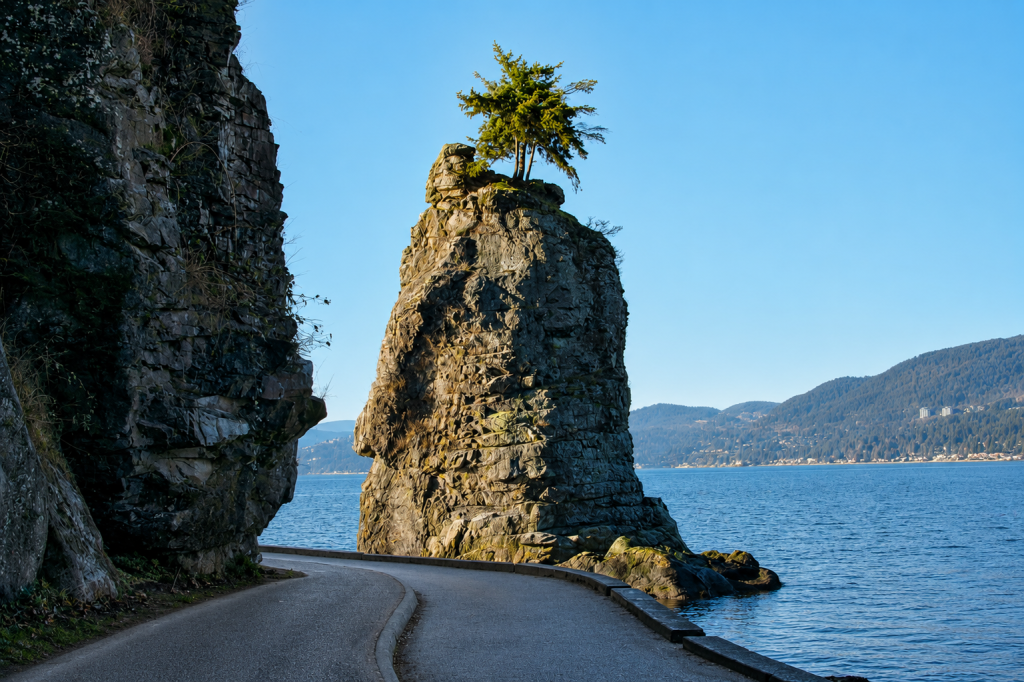
From the Hollow Tree or the seawall, follow the Merilees Trail and branch off onto the roughly 0.8 km (half-mile) Siwash Rock Trail down to the shoreline — and there it is, one of the park’s most legendary landmarks.
Formed by volcanic activity around 32 million years ago, Siwash Rock is the only sea stack in Metro Vancouver. It stands about 15–18 metres tall, and somehow a Douglas fir has taken root and clings to the very top — life staking its claim in the most stubborn way possible (honestly, it’s a little moving once you spot it).
This rock carries deep spiritual significance for the local Squamish people. Because the older name “Siwash” carries derogatory colonial connotations, the City of Vancouver has been actively working to restore its traditional Indigenous name, Slhx̱í7lsh (meaning “the standing man”). As the legend goes, the rock is actually a warrior — a father — who held fast to his beliefs and his purity for the sake of his descendants, and was transformed into an eternal stone pillar to watch over these waters.
The trail down passes through a stretch of seriously dense forest. The whole walk only takes about 15–20 minutes, but the vibe is completely different from the seawall — it feels like you’ve wandered into a scene out of Lord of the Rings. One heads-up: in winter, the Vancouver Park Board sometimes closes this section of seawall between Prospect Point and Third Beach for cliff-stabilization work or storm-damage repairs, so it’s worth checking the official site for closure notices before you head out.
8️⃣ Vancouver Aquarium: One of North America’s Leading Marine Conservation Centres
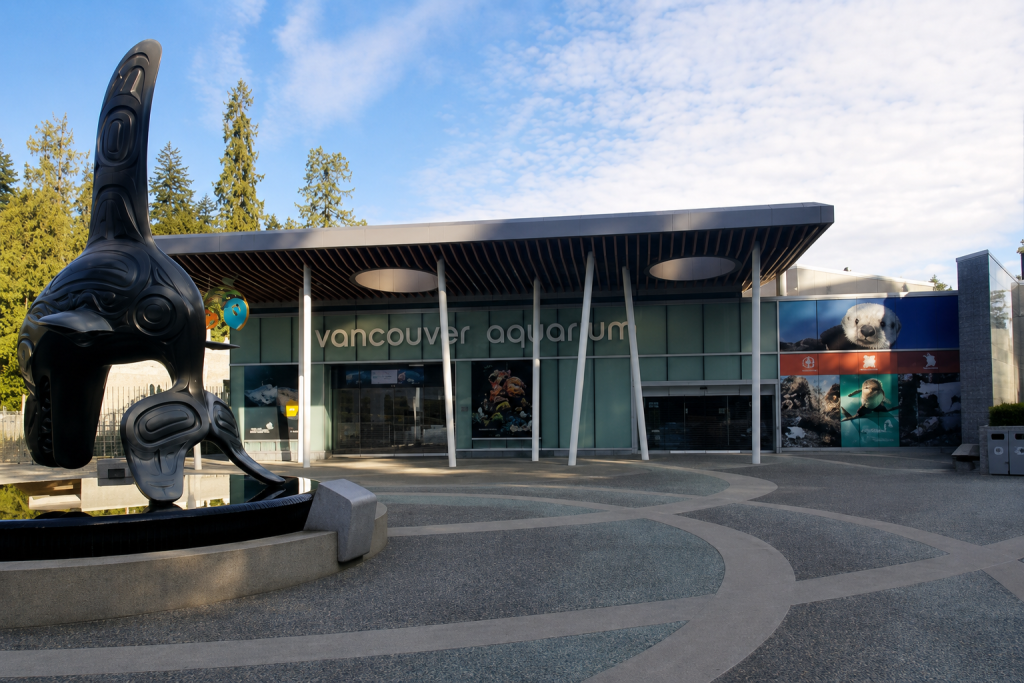
If you’re travelling with kids — or you’re an aquarium person yourself — this one’s worth slotting into the itinerary. The Vancouver Aquarium is one of the largest aquariums in Canada and a major marine conservation and rescue centre in North America.
⚠️ Important update (a lot of older articles miss this): Following Canada’s 2019 law banning the keeping and breeding of whales and dolphins, the aquarium’s last dolphin was relocated in April 2021. So there are no more orca, beluga, or dolphin shows here anymore — please don’t go expecting a cetacean performance.
Even without the whales and dolphins, there’s still plenty to see. Highlights include:
- The jellyfish gallery (utterly dreamy under the blue light — you’ll completely lose track of time 💙)
- Sea otters, sea lions, and seals (the sea otters are criminally cute)
- Penguins, the Amazon rainforest exhibit, and the Pacific Northwest coastal marine ecosystem display
- All kinds of Pacific and global marine life
🎫 Good to know: Admission uses dynamic pricing (adult tickets run roughly CAD $39.95–$55.20 depending on the season and whether it’s a weekday or weekend). I’d recommend buying online ahead of time to skip the lineup. As of 2026, the aquarium has gone fully cashless — on-site they only accept credit, debit, or Apple Pay / Google Pay, so make sure you’ve got a digital payment method ready.
🥚 Fun fact: A lot of people go hunting for a “natural history museum” inside Stanley Park, but the only such facility in the park is the aquarium. The real natural-history heavyweight is the Beaty Biodiversity Museum on the UBC campus (2026 adult admission CAD $18, open all week in summer), which holds millions of specimens. Its atrium even features Canada’s largest blue whale skeleton, stretching 26 metres (about 85 feet) — so don’t end up at the wrong place, nature lovers!
9️⃣ 【2026 Full Suspension Alert】Stanley Park Train
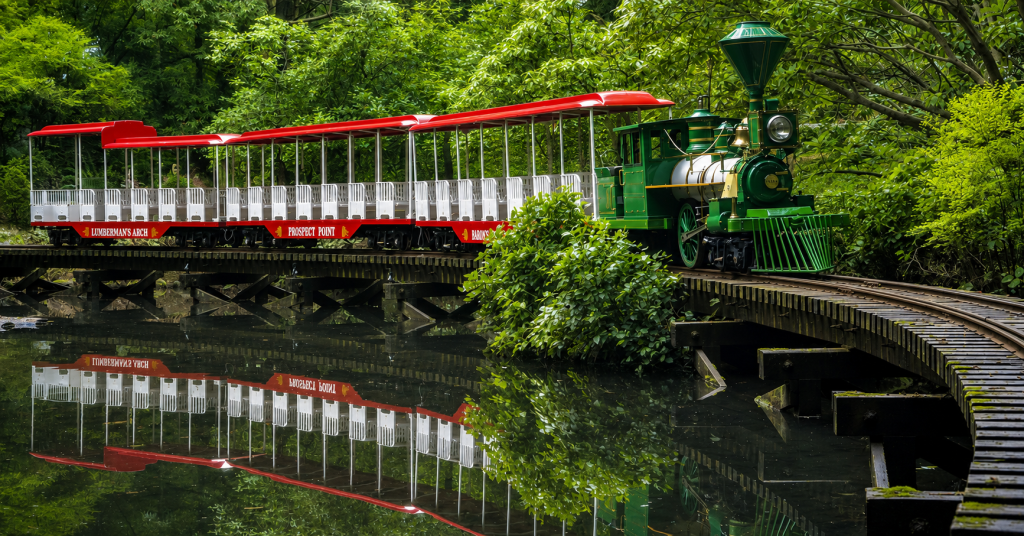
⚠️ Latest 2026 official notice: Due to safety concerns from an aging engine and exhaust system, the Stanley Park Train has been indefinitely suspended through 2025 and 2026. The Vancouver Park Board is currently seeking a new third-party operator to upgrade the facility, with new attractions not expected to return to the area until mid-2027 at the earliest.
The much-loved seasonal events — the Halloween Ghost Train and the Bright Nights Christmas light train — are all cancelled for 2026 as well. Be sure to steer clear of this pitfall when planning your trip, so the little ones don’t end up disappointed.
🔟 Lumbermen’s Arch Kids’ Water Park
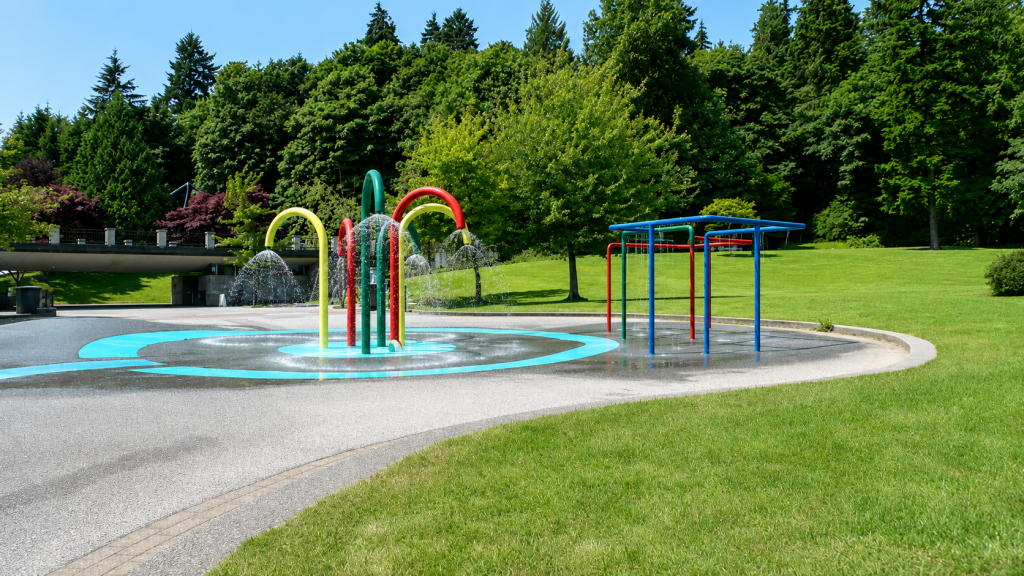
The park has a summer-only (open daily 9 a.m. to 7 p.m.) free water park, where water shoots up out of jets in the ground. To support Vancouver’s 2026 water-conservation policy, the jets have switched to a push-button system — each press runs the water for 5 minutes — so the kids can splash around to their heart’s content. I was the kid being dragged to places like this by my parents back in the day. Those little corners are exactly the kind of thing that carries a whole childhood summer 🥹
There are picnic tables and snack stands nearby too, so bringing your own lunch for a picnic is no problem at all.
🏖️ Stanley Park’s 3 Main Beaches & English Bay
🌅 Third Beach: The Gold Standard for Sunsets
If you ask me “where’s the best place in Stanley Park to watch the sunset,” I’ll point you straight to Third Beach, no hesitation.
This is the park’s westernmost beach — fine sand, gentle waves, and facing out toward the Pacific at just the right angle to catch the sunset. In the evening, locals come down to picnic and unwind. I especially recommend coming on a summer Tuesday evening, when the beach hosts “Brahm’s Tams,” a drum circle that’s been going for over 20 years. Hundreds of people bring their hand drums and dance alongside the giant driftwood logs as the sun goes down — the vibe is unbeatably chill. People love to lean back against the logs and watch the cargo ships drift slowly into the harbour. Even if you come in the shoulder season, there’s this cinematic “the world is so quiet” feeling to it.
👨👩👧👦 Second Beach: Great for the Whole Family
Keep heading south and you’ll come to Second Beach. Compared to Third Beach:
- Busier and more lively
- Has a heated outdoor pool open in summer (2026 adult admission is CAD $7.93, free for kids under 4)
- There’s a playground and picnic area right beside it. 💡 Must-read for 2026 bookings: The City of Vancouver reserves 75% of pool spots for online reservations, so I’d strongly suggest grabbing your spot at noon, three days in advance, through the Showpass system. Only a small number of drop-in spots are left for the on-site lineup.
- Ideal for families with kids, but not the place if you’re after a quiet spot to switch off
🤣 English Bay: The City Beach Closest to Downtown
Technically English Bay isn’t within Stanley Park itself, but it sits right by the park’s southern exit, so if you ride the seawall to the very end you’ll naturally land here. It’s Vancouver’s most popular city beach, and the go-to spot for locals to unwind after work or on weekends. There are a few stops I make every single time:
- A-maze-ing Laughter: 14 wonderfully unhinged bronze figures caught mid-laughter, created by Chinese artist Yue Minjun in 2009. Each one stands 2.59 metres tall and weighs 250 kg — a legendary piece from the 2009–2011 Vancouver Biennale. The Wilson family (founders of Lululemon) bought the installation in 2012, and it now lives permanently in Morton Park beside English Bay. Off-the-charts photogenic 😂
- The Inukshuk: A navigational and welcome marker rooted in the Indigenous cultures of northern Canada, symbolizing northern hospitality and friendship. This 30,000-kg granite landmark was built by Inuit artist Alvin Kanak as a legacy of Expo ’86, relocated to English Bay in 1987.
- Giant driftwood logs on the beach: Lots of people just plop down on a log to zone out and watch the sunset.
- The seaside hot dog stand: The street-stand hot dogs are surprisingly good — give them a try.
- Summer Lights in English Bay: The old international fireworks competition (Celebration of Light), where teams from different countries went head-to-head over the water, has been indefinitely discontinued after years of dried-up sponsorship funding. The City of Vancouver has since taken over, launching a brand-new, free single-night fireworks celebration at English Bay over the BC Day long weekend in summer, complete with a whole row of food trucks. It’s a stunner (please check the official site for confirmed dates).
💡 Quick heads-up: The water at English Bay isn’t exactly crystal clear — it looks gorgeous from a distance, but up close you’ll notice it’s a bit silty. It’s really for taking in the view and going for a stroll, not so much for swimming (though plenty of people still hop in during summer).
🎨 Granville Island: An Industrial Site Reborn as a Foodie & Art Haven
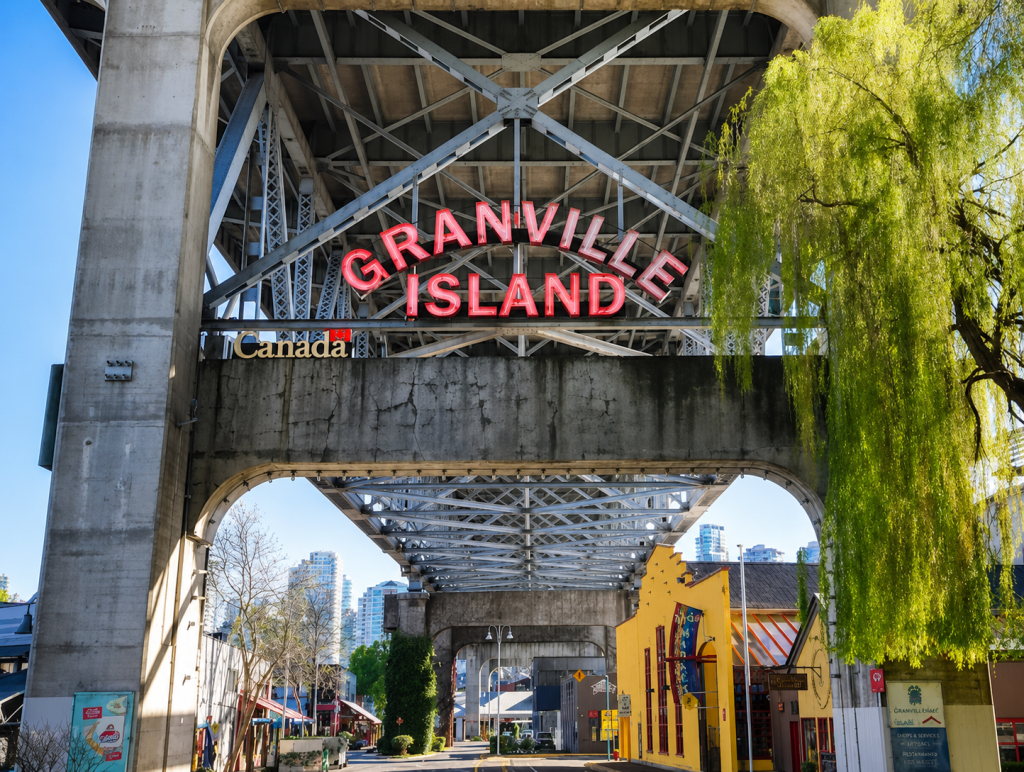
If you’ve still got half a day to spare, I highly recommend carrying on from English Bay over to Granville Island.
It’s not actually a true “island” — it’s a little peninsula tucked into False Creek. In the early 20th century this was an industrial sandbar packed with sawmills, machine shops, and warehouses. Then in the 1970s the whole area got a major makeover, transforming into the tourist hotspot you see today — a mix of creative studios, markets, restaurants, and galleries. It’s a textbook example of successful urban renewal.
⛴️ How Do You Get to Granville Island? Hop on a Cute Little Water Ferry
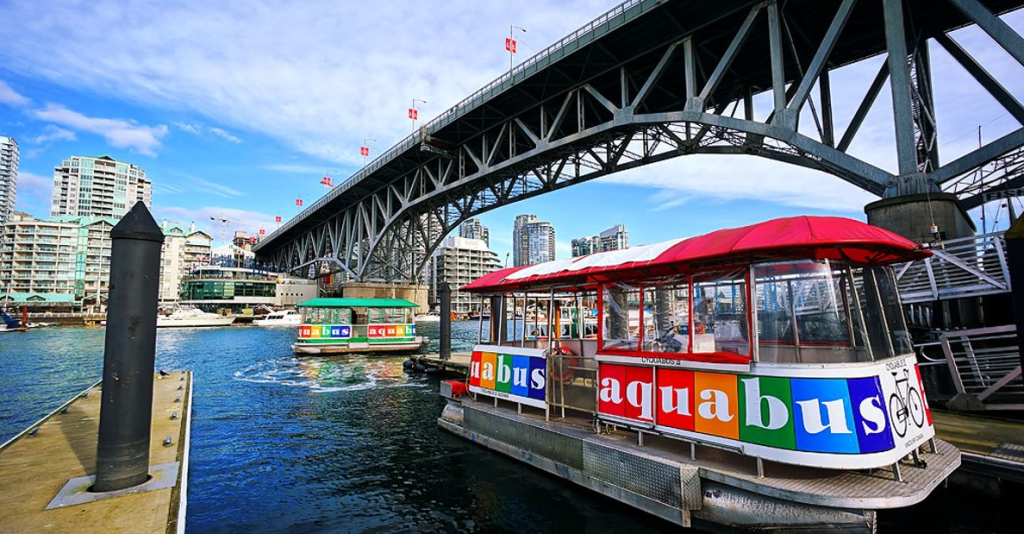
The most fun way to get there — and the best way to dodge those brutal weekend traffic jams — is to hop on a mini water ferry. There are two companies running here:
- Aquabus: The classic rainbow-coloured boats. You can bring your bike along, but heads up — only the larger platform-style boats have the room for bikes, and there’s an extra $1 CAD bike fee.
- False Creek Ferries: The blue boats, the original veterans that have been running for over 40 years (⚠️ Note: bikes are completely banned on the blue boats, so cyclists, make sure you don’t show up at the wrong dock!)
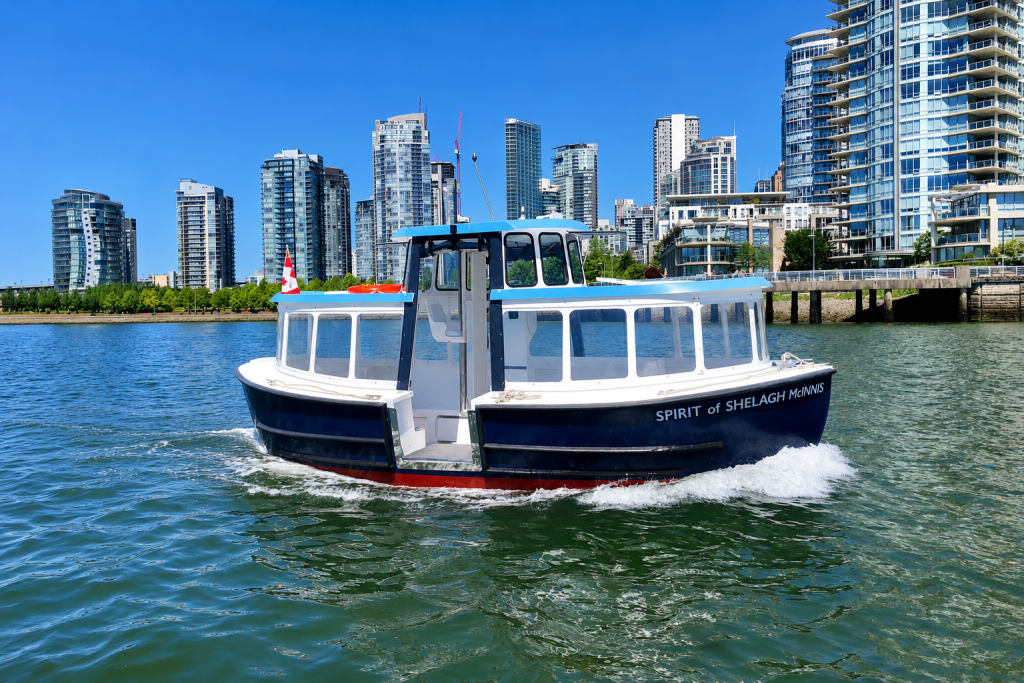
Both start running at 7:00 a.m. False Creek Ferries wraps up around 9:00 p.m., while Aquabus keeps going until 10:00 p.m. During peak times they come every 5 to 15 minutes, and they run year-round (except Christmas Day). They stop at 9 different docks including Yaletown, David Lam Park, and Science World, so you can hop on and off to explore different areas.
💰 Fares (2026): The short hop over to Granville Island starts at around CAD $4.25 one-way (longer routes cost a bit more, up to $10–12). If you’re planning to spend the whole day cruising along the waterfront, I’d strongly recommend grabbing a Hop-On Hop-Off day pass for about CAD $22.
📌 Quick fact-check: Some articles online list the one-way fare as $7–8, but the basic trip to Granville Island actually starts at $4.25. One more thing to keep in mind — both of these are private ferries, and they still don’t accept the Compass Card. So remember to bring a credit card for Tap to Pay, or buy your e-tickets ahead of time on their website.
From downtown (along Granville Street, for example), you can also take the #50 bus over. Hop off at the Anderson St stop and it’s just a short walk — about 15 minutes total. The best part: the #50 takes your Compass Card or day pass directly, making it the most budget-friendly land route.
🍤 The Public Market: A Foodie’s Paradise
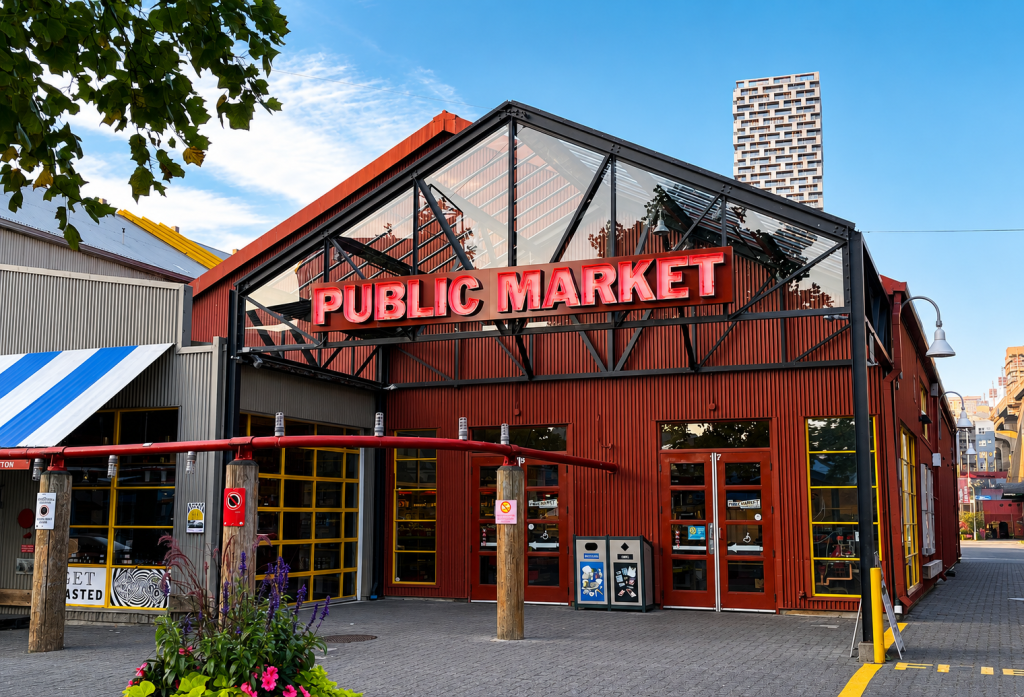
Once you step onto Granville Island, your first stop absolutely has to be the Public Market. Good news: to keep up with the ever-growing crowds, the market rolled out an extended-hours plan in 2026 and now stays open daily from 9 a.m. all the way to 8 p.m. I’d highly recommend heading over in the late afternoon to dodge the midday crush. The moment you walk in, you’re hit with the scent of fresh berries and just-baked bread — and honestly, they’ve got everything:
- Fresh produce arranged like works of art
- All kinds of cheeses, breads, and chocolate
- Classic Canadian maple syrup products
- Seafood stalls (oysters, shrimp, crab)
- The Stock Market (the soup spot): Home to some seriously famous chowder. This soup specialist sticks to all-natural ingredients with nothing artificial added — the creamy clam chowder and seafood chowder are absolute must-tries.
🍩 My personal, worth-the-line picks:
- Lee’s Donuts: A family-run institution that’s been around since 1979 and is now a genuine Vancouver legend. Their signature “Honey Dip” is a fresh-out-of-the-fryer handmade yeast donut coated in warm honey glaze, with dough so soft it practically melts in your mouth. The generously stuffed “Raspberry Filled” is another favourite — bite into it and warm, sweet-tart jam bursts out. This beloved old shop has been part of Vancouverites’ lives for nearly half a century, and it still draws the longest lineups in the market on weekends, holding on to the same all-handmade yeast recipe and old-school charm it’s had since 1979.
- Nanaimo Bar: A national-treasure dessert you simply have to try in Canada. This no-bake treat comes in three layers — a chocolate crumb base mixed with nuts and coconut, a rich yellow custard icing in the middle, and a thick chocolate ganache on top. It’s sweet to the max, but pair it with a cup of unsweetened black coffee and it’s a perfect match. If you want to take some home as a gift, I highly recommend the lovely specialty shop in the market called “Northern Bars.” They offer not just the classic original but also flavours like espresso and chocolate banana, all beautifully packaged and perfect for travelling.
- Go Fish Fish & Chips (the hidden gem): This little blue-walled tin shack isn’t inside the indoor market — instead, it’s tucked away near the entrance to Fisherman’s Wharf, just slightly off the main seawall path. Its cod, halibut, and salmon come straight off the fishing boats moored less than 30 feet away, so the freshness is unbeatable! Beyond the fish and chips, their “Tomato Miso Chowder” — a clever fusion of Japanese and West Coast flavours — is a real insider favourite. Pay close attention to the hours! Go Fish runs year-round, but it’s closed every Monday. Weekday hours are 11:30 a.m. to 6:00 p.m., and weekends 12:00 to 6:00 p.m., so plan ahead and don’t make the trip for nothing.
Once you’ve grabbed your food, head to the outdoor seating area to eat while taking in the views of False Creek. There are often street performers around too — the vibe is fantastic.
⚠️ Watch out for the crows and seagulls! They’ll legit dive-bomb you to snatch your food — they’re seriously aggressive, so keep your eyes peeled 👀
🖼️ Artist Studios & Little Shops
Beyond the market, the whole island also has:
- Independent artist studios: Watch potters and glass artisans create their work live
- Granville Island Brewing (craft brewery): When your feet get tired, pop into the attached taproom for a locally brewed pint. The tasting room is open seven days a week, from noon to 8 p.m. Monday through Thursday, with an earlier 11 a.m. start on weekends
- Indie bookstores and curated boutiques
- Kids Market: Bring the kids and you could easily spend a whole afternoon here. This old building houses a multi-floor Adventure Zone plus the popular interactive i-Wall — the perfect backup plan for burning off the little ones’ energy
🕰️ The Gastown Steam Clock: Uncovering the Truth Behind the “Fake Antique”
After exploring Stanley Park and Granville Island, you can wrap up your day in Gastown.
This is Vancouver’s oldest neighbourhood (the city itself got its start here back in the 1870s), and with its cobblestone streets, red-brick buildings, and vintage lampposts, it has a completely different feel from the rest of downtown — perfect for a stroll and some photos. Heads up! In the summer of 2026, the main drag, Water Street, will go fully car-free every Sunday from noon to 8 p.m. under a new “pedestrian-only program.” The street fills up with outdoor patios and live music, making it the best time of year to wander and snap photos! Everyone eventually gathers at the corner of Water Street and Cambie Street, waiting to watch the white-steam-puffing Steam Clock — but here’s the thing: this piece of modern art, built in 1977 by the late, legendary clockmaker Raymond Saunders, has run into some trouble lately. As of 2026, a serious internal mechanical failure has left the clock’s hands completely stuck, so it can’t show the correct time. Don’t worry though — the independently running steam-whistle system is still going strong, faithfully puffing out steam every 15 minutes and playing the classic Westminster chimes.
🔍 The Steam Clock: Historical Myths vs. Mechanical Reality
If you assumed it’s a 19th-century antique that witnessed Vancouver’s founding, you’d be way off! Time for a fact-check:
| Steam Clock Myth | The Real History & Mechanics |
|---|---|
| Year built | 1977 — not a 19th-century antique |
| Who made it | Local clockmaker Raymond Saunders (who passed away in November 2024 at the age of 84) |
| Cost | Around CAD $58,000 (he originally estimated $25,000 — and went way over budget 😅) |
| Why it was built | To cover up a steam vent on the corner that kept blowing out hot air (Vancouver has an underground steam-heating system), while also reviving tourism in a then-declining Gastown |
| How it works | Mainly powered by gravity (steel balls sink by their own weight to drive the clock) plus a steam engine. But the steam power was unstable and noisy, so the steam motor broke down after about ten years — after which an electric motor took over lifting the steel balls and handling the venting. ⚠️ 2026 traveller reality check: The clock is currently dealing with a serious mechanical failure — the hands are stuck and showing the wrong time, and the city is waiting on custom parts to repair it. |
| The role of the steam | The five whistles up top are still 100% powered by real steam! |
| Chime schedule | Every 15 minutes it blows steam and plays the Westminster Chimes (the same melody as London’s Big Ben); the steam is at its biggest on the hour, making it the best time for photos |
So even though it’s “younger” than you’d think and its power is now electrically assisted, it’s still one of the very few working steam clocks left in the world (the first recognized steam clock was built by John Inshaw in England back in 1859).
🎓 Fun fact: Raymond Saunders went on to build steam clocks in Otaru (Japan), Indianapolis (USA), Whistler, and Port Coquitlam — so yes, that nearly identical steam clock in Otaru, Hokkaido really is a sister piece by the very same craftsman! Word has it this clock even appeared on the cover of Nickelback’s 2011 album Here and Now (with the clock hands deliberately set to 11:21 as a little Easter egg), and it shows up as the “Vancouver Velocity” track in Nintendo’s Mario Kart Tour as well as Mario Kart 8 Deluxe on Switch.
📸 Photo tip: I’d suggest staking out your spot a little before the top of the hour, since the area is always packed with tourists holding up their phones. Daytime is when your shots will come out clear and crisp. Also, in the summer of 2026, Water Street in the heart of Gastown will become a Sunday Pedestrian Zone, fully closed to cars every Sunday from noon to 8 p.m. — the golden window for relaxed, car-free photos. If you’re driving, remember to steer clear during those hours so you don’t get detoured.
🚨 Must-Read for Visitors: Gastown’s Borders & A Safety Guide
As a responsible blogger, I have to give you an honest heads-up about safety around here. Gastown is buzzing during the day, but it sits right next to the Downtown Eastside (DTES) — the most troubled neighbourhood in all of Vancouver.
- No-go zone: The DTES, especially along E Hastings Street (roughly between Carrall Street and Jackson Ave), is widely recognized as the epicentre of homelessness and the worst fentanyl crisis in North America. And don’t let curiosity pull you on an endless wander into the side alleys to the southeast (like around Blood Alley) either.
- Safe walking route: A lot of maps will tell you to head straight south from Gastown along Carrall Street to reach Chinatown — please, whatever you do, skip that shortcut! The safer way is to walk west along Water Street back to Richards Street, head south up the hill to W Pender Street, then follow the main road east into Chinatown.
- Safe Walk service after dark: If you find yourself out late at a Gastown bar, the Downtown Vancouver Business Improvement Association (now Downtown Van, formerly DVBIA) runs a free Safe Walk program. Just download the “Downtown Van App” or call the dedicated line at 604-689-4357 to request it. Core hours run daily from 8:30 AM to 10:30 PM (some community outreach patrols stretch to 11:00 PM), and a trained safety ambassador will walk you to your hotel or SkyTrain station in person, or stay on the phone with you the whole way.
The main tourist stretch is honestly tiny — a round trip along Water Street takes maybe 15 minutes. My advice: visit during the day, and stick with a group at night. Solo women especially shouldn’t be wandering around alone after dark.
⚓ Waterfront Station & Canada Place
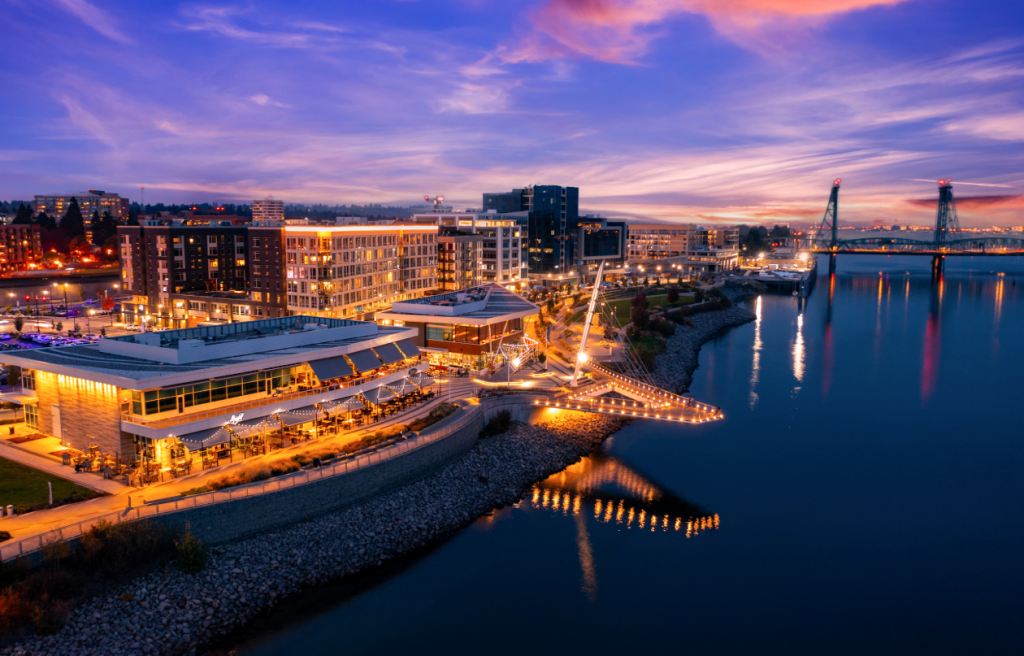
Right next to Gastown you’ll find Waterfront Station, Vancouver’s most important transit hub:
- SkyTrain (Canada Line, Expo Line)
- SeaBus (across to North Vancouver)
- West Coast Express commuter rail
- Multiple bus routes
⚽ 2026 World Cup transit tip: To handle the FIFA World Cup matches happening at nearby BC Place in summer 2026, TransLink is ramping up service in a big way — during peak match times, SkyTrain frequency drops to roughly one train every 2 to 2.5 minutes. On nights with evening matches, the last northbound SeaBus to North Van is even being extended (a real rarity) to depart Waterfront as late as 2:22 AM, and the West Coast Express will add special trains on match weekends. I’d recommend downloading the Transit App or the TransLink App to stay on top of real-time updates, and keep an eye out for the limited-edition “Compass Soccer Mini” commemorative transit card.
But Waterfront is more than just a station — the harbour itself is an attraction.
🚢 Canada Place & the International Cruise Terminal | 2026 Cruise Season Transit Guide
Canada Place sits right beside it — that iconic building with the five white sail-shaped roofs. It’s the landmark you’ll spot on more Vancouver postcards than any other, and it’s also the city’s cruise home port. The 2026 cruise season is noticeably longer than in past years, running from early spring right through to fall, with a record-breaking 360 cruise ship calls expected over the year. There’s an Alaska-bound ship docking almost every single day, and trust me — until you’ve stood in front of one of these vessels towering several storeys high, you really can’t appreciate how jaw-dropping the sight is. One heads-up: during the 2026 World Cup, downtown will see tens of thousands of cruise passengers pouring in, so do your best to take public transit and steer clear of travelling during peak hours.
There are also a few super photogenic public art pieces around the plaza:
- Digital Orca: Created by well-known Vancouver author and artist Douglas Coupland in 2009, this piece captures a killer whale breaching the water in a pixelated, building-block style. It’s an orca with zero curves, assembled entirely from black-and-white cubes — seriously cool.
- The Drop: Created by the German art collective Inges Idee, this sculpture stands a towering 20 metres (65 feet) tall, representing a giant raindrop at the very moment it hits the ground — a fitting nod to Vancouver’s rainy reputation as “Raincouver.”
- FlyOver Canada: Located inside Canada Place, this is an Immersive Flying Theatre that uses a 20-metre spherical screen and suspended seating, rather than a traditional IMAX 3D setup. Much like Disney’s Soarin’, it uses hanging seats, wind, mist, and scent effects to whisk you on a bird’s-eye flight over Canada’s glaciers, prairies, and coastlines. The signature feature film for 2026 is “Awaken Canada,” with other popular themes screening on a rotating, limited-time basis. It’s the perfect backup plan for a rainy Vancouver day.
🛩️ Vancouver Harbour Flight Centre & the Floatplanes
Along the harbour you’ll also spot a floatplane terminal — its official name is actually the Vancouver Harbour Flight Centre. These little planes take off and land right on the water, offering several daily routes to and from coastal towns across British Columbia, flying to spots like Victoria’s Inner Harbour and Whistler’s Green Lake. As of summer 2026, there’s even a new cross-border direct route to and from Seattle’s Lake Union.
I’ve taken a floatplane over to Vancouver Island myself, and the whole trip takes only about 35 minutes — way faster than the ferry. Seeing Vancouver’s coastline from the air is absolutely stunning, and it’s an experience I’ll never forget 🛩️
🌷 Bonus Spot: Queen Elizabeth Park
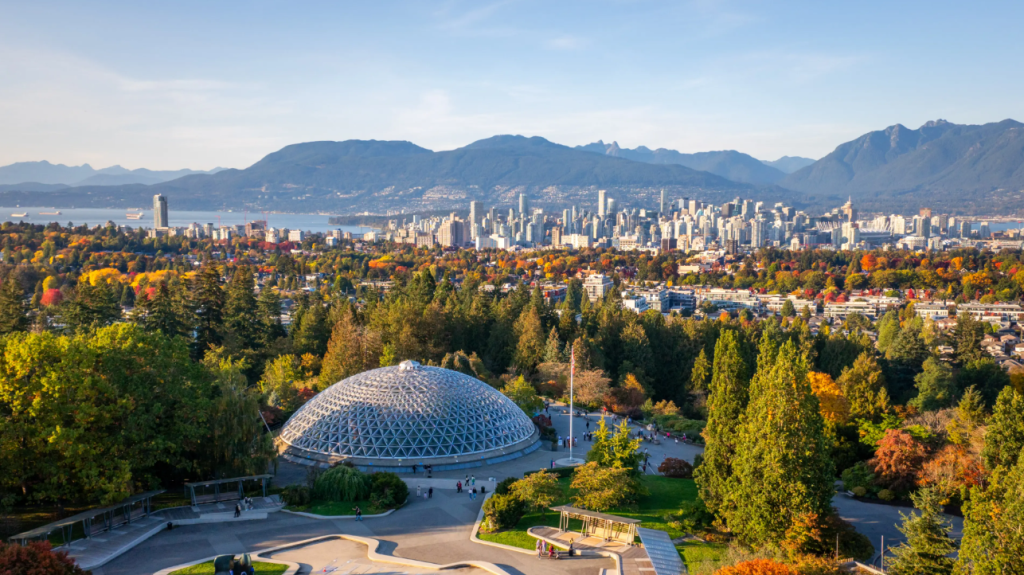
If Stanley Park represents the wild and untamed side of nature, then Queen Elizabeth Park is the crowning achievement of refined, human-cultivated gardening.
It sits atop the city’s highest point, “Little Mountain” — the tallest spot within Vancouver proper — just about a 15-minute drive from downtown, and easy to reach whether you take transit or drive yourself. The key highlights:
- Bloedel Conservatory: A massive lattice-glass dome built atop the highest volcanic outcrop in central Vancouver, which officially opened in 1969. It’s Canada’s first and still largest single-structure geometric Triodetic Dome conservatory, and it’s listed as a Grade-A heritage site. Step inside and you’re instantly transported to a tropical rainforest, home to over 500 species of exotic plants, plus a hundred-odd free-flying tropical birds like macaws and pheasants, along with a wonderfully zen Japanese koi pond. This is hands-down the perfect indoor escape from the cold during Vancouver’s rainy season or winter.
- The highest viewpoint & the Dancing Waters Fountain: The plaza outside the conservatory offers a flawless panorama of the downtown skyline, the waters of False Creek, and the snow-capped North Shore mountains. Right beside it, the “Dancing Waters Fountain” sends jets of water rising and falling in rhythm — a real treat to watch.
- Quarry Gardens: Once a huge quarry that supplied building materials for the city, this space has been transformed by some clever design into a richly layered sunken garden. There’s an elegant little Japanese bridge on the north side, making it a favourite among photography enthusiasts.
- Recreation facilities: A standard 18-hole 1,237-yard Pitch & Putt golf course (no single hole over 110 yards), plus 17 public tennis courts and lawn bowling greens. When you’re tired of exploring, you can book a table at the renowned Seasons in the Park restaurant and enjoy refined Western cuisine with a view — for 2026, they’re offering a $56 CAD three-course surprise lunch on weekdays, and on Sunday evenings, a $52 CAD prime rib-eye steak served with Yorkshire pudding.
🍴 Vancouver on Your Tongue: Where Japanese Cuisine Meets North American Street Food
Vancouver’s enormous Asian population, paired with its abundant Pacific seafood, has given rise to a world-class style of “Fusion Japanese Cuisine” unlike anywhere else. This city isn’t just a battleground for top-tier sushi — it’s also the birthplace of the California Roll (originally the “Tojo Roll”) and the BC Roll, having nurtured legendary dishes that changed the course of North American food history. By 2026, Kissa Tanto — a one-Michelin-star restaurant blending Japanese and Italian aesthetics, famous for its thin noodles with miso-cured egg yolk — has pushed contemporary fine-dining fusion Japanese to brand-new heights.
🌭 A Street Food Legend: Japadog
Back in 2005, Tokyo advertising salesman Noriki Tamura moved to Vancouver with his wife. He originally dreamed of opening a Japanese crêpe stand, but had to compromise because Vancouver’s street-vendor regulations at the time were incredibly strict (you could only sell hot dogs and roasted chestnuts). Unwilling to settle for ordinary, he boldly piled Japanese teriyaki sauce, bonito flakes, seaweed, and grated daikon onto a juicy American hot dog — and created the line-up-worthy sensation that is Japadog! Today it has grown from a single food cart into a culinary empire with brick-and-mortar locations and even international branches, and the late food show host Anthony Bourdain once paid it a visit in person.
- The must-order signature: The most popular item is the Terimayo series — a juicy sausage drizzled with sweet-and-savoury teriyaki sauce and Japanese mayo, then topped with heaps of shredded seaweed and fried onions. Bite in and the juices burst out — so satisfying! The version made with premium Kurobuta (Berkshire pork) sausage is a long-time bestseller.
- If you want something filling: The Tonkatsu (breaded pork cutlet hot dog) tucks a thick-cut deep-fried pork cutlet into the bun, paired with shredded cabbage and a savoury umami sauce — full marks for keeping you full.
- A side to add: Don’t forget their Shaked Fries — go for the “Butter & Shoyu” or “Aonori (seaweed)” flavour, and I guarantee you won’t be able to stop at just one handful.
🍣 The Origins of Vancouver’s California Roll: Hidekazu Tojo, the World-Changing Father of Sushi, & the BC Roll
Did you know? The globally beloved “California Roll” may very well have been born right here in Vancouver!
In 1971, Osaka-born chef Hidekazu Tojo arrived in Vancouver. He noticed that North American diners at the time were quite put off by raw fish and couldn’t handle the “ocean-y” taste of the seaweed on the outside of sushi, so he flipped the roll inside out (the uramaki), wrapping the rice on the outside to hide the seaweed, and switched to ingredients locals loved — cooked crab meat, avocado, and cucumber. This is the origin of what later came to be known as the “California Roll,” thanks to all the Los Angeles diners who couldn’t get enough of it.
📌 An honest heads-up: The “true inventor” of the California Roll is actually a matter of debate. Tojo is the most widely cited claimant, and was even named a Goodwill Ambassador of Japanese Cuisine by the Japanese government, but there are also sushi chefs in Los Angeles (like Ichiro Mashita of Tokyo Kaikan) who claim to have made a similar roll earlier, and scholars still haven’t reached a consensus. Either way, Tojo’s place in Vancouver’s sushi history is beyond question.
The dish that’s 100% Tojo’s very own signature creation, though, is the “B.C. Roll”: Traditional Japanese sushi often uses saltwater eel (Anago), but that’s hard to come by on Canada’s west coast. So in 1974, Tojo had a flash of inspiration and switched to wild Pacific salmon, which BC has in abundance — grilling the salmon skin until golden and crispy, brushing it with a special sweet sauce, and rolling it into the sushi. With its irresistible smoky flavour and crispy texture, the BC Roll instantly became one of Vancouver’s most iconic local dishes. Some innovative restaurants even add asparagus or mango, the fruit’s gentle sweetness perfectly balancing out the richness of the salmon.
If your budget allows, I highly recommend heading to his namesake restaurant, Tojo’s Restaurant, and ordering an “Omakase” (chef’s-choice tasting menu) curated by the master himself — a chance to experience the craft of this legendary chef firsthand.
🍱 Top-Tier Sushi Without the Splurge: Tom’s Sushi
If you’re craving high-calibre nigiri downtown but don’t want to drop a fortune, Tom’s Sushi on Davie Street is your go-to. Founded by chef Tom Jeon, it serves up incredibly fresh catches at wonderfully wallet-friendly prices.
- Must-try: The “Salmonholic Roll” layers crab, avocado, torched salmon, and sweet potato for an incredibly rich mix of textures. Their inventive roll with a hit of mango is a delightful surprise, too.
- Heads up: The spot is small and always busy, so expect a 30–45 minute wait during peak hours. Make good use of their text-message waitlist system.
☕ 49th Parallel Coffee Roasters
Vancouver has a seriously deep coffee culture, and 49th Parallel is one of the city’s most iconic specialty roasters. Beyond their excellent espresso, the doughnuts are the real showstopper here—I especially recommend the “Salted Caramel Old-Fashioned.” That signature dense, cracked old-fashioned crust comes drenched in gooey caramel sauce and finished with a few flakes of sea salt. It’s the perfect way to kick off a Vancouver morning.
💸 Important dining note: Menu prices at Vancouver restaurants don’t include tax or tip! When the bill comes, you’ll first see a 13% sales tax added on, and when you tap your card, the machine will prompt you for a tip—locally, that’s an extra 15–20%. So your final tab usually runs nearly a third higher than you’d expect. Best to brace yourself.
🚇 The Complete Vancouver Transit Guide: How the System Works & Money-Saving Tips
Vancouver boasts one of Canada’s most comprehensive public transit systems (TransLink), and with the 2026 World Cup on the horizon, getting a handle on the fare logic and transit cards is key to keeping your budget in check.
🚈 SkyTrain Routes
Vancouver’s rapid transit mostly runs along elevated tracks above ground and is fully automated and driverless. There are currently three main lines in operation:
- Canada Line: The one tourists use most, running between downtown and Vancouver International Airport (YVR), with some trains continuing on to Richmond.
- Expo Line: Connects downtown with Burnaby, New Westminster, and Surrey.
- Millennium Line: Links the eastern part of the city out to Burnaby, Port Moody, and Coquitlam.
💳 Zone-Based Fares & the Latest 2026 Price Increases
Metro Vancouver is split into Zones 1, 2, and 3, and your fare depends on how many zones you cross. Here are the latest fares after the 2026 increase:
| Zones Crossed | Example Coverage | Cash / Contactless Single Fare | Compass Card Single Fare |
|---|---|---|---|
| Zone 1 | Downtown, Stanley Park | $3.50 | $2.85 |
| Zone 2 | Downtown to North Vancouver, Richmond, Burnaby | $5.10 | $4.20 |
| Zone 3 | Downtown to Coquitlam, Surrey, and other outer suburbs | $6.70 | $5.40 |
| Day Pass | Unlimited rides across all zones | $12.55 | $12.55 |
💡 A huge perk for families: Beyond knowing the adult fares, BC has rolled out its “Kids 12 and Under Ride Free” policy province-wide. As long as they’re with a paying adult, kids can ride the entire TransLink network for free!
🎫 The Must-Have Card: Your Compass Card Playbook
Much like Taipei’s EasyCard, the Compass Card is an essential tool for getting around Vancouver.
- Buying one: Pick it up at any SkyTrain station vending machine with a refundable $6 deposit, plus a minimum $5 load, and the card never expires. I’d suggest registering it online right after purchase—that way, if you ever lose it, you can freeze your balance and transfer it to a new card.
- 90-minute free transfers: Within 90 minutes of tapping in, you can transfer for free as many times as you like between buses, the SkyTrain, and the SeaBus. The system only charges the zone fare for a single journey—this is the single most important money-saving feature.
- Bus-specific rules: No matter how many zones you cross, buses always charge a single flat Zone 1 fare. You only need to “tap on at the front door when boarding“—just hop off through the rear door when you reach your stop, and whatever you do, don’t tap again or you risk being charged twice.
- ⚠️ Contactless payment has no cap: Any contactless Visa / Mastercard / Amex credit card, or Apple Pay / Google Pay, can be tapped right at the gate—you’ll pay the cash fare with no need to load up a card first. But take note: Vancouver’s TransLink currently has NO daily payment cap (no fare capping), so every tap just keeps adding up with no limit, and it’s easy to blow past the $12.55 day pass. If you’re planning four or more trips in a day, just grab a physical Day Pass at the vending machine.
- ⚠️ The YVR airport surcharge trap: Whenever you leave the airport for the city from any of the three on-airport stations (YVR-Airport, Sea Island Centre, Templeton), the system automatically tacks on a $6.50 airport surcharge (AddFare)—the first major hike to this fee in over a decade. Direction matters: this charge only applies when you’re “leaving the airport into the city.” Going the other way—when your trip wraps up and you’re “heading from the city to the airport to catch your flight”—it’s completely free.
💡 The golden money-saving window: After 6:30 p.m. on weekdays, plus all weekends and statutory holidays, the entire system charges a flat Zone 1 fare—the perfect time for those longer-distance trips!
🛍️ Just for Taiwanese Travellers: How to Shop for Great-Value Vancouver Souvenirs
No trip abroad is complete without coming home loaded with goodies! Based on what Taiwanese travellers tend to love, I’ve put together this foolproof must-buy list for you:
| Souvenir Category | Why It’s Great | Where to Buy & Insider Tips |
|---|---|---|
| 🍷 Premium Ice Wine | Canada is the world’s largest producer of quality ice wine, made from grapes left to freeze naturally in extreme cold—sweet, rich, and bursting with notes of peach and lychee | In Metro Vancouver, I recommend the Taiwanese-owned Lulu Island Winery. One heads-up, though: the winery has now discontinued its international direct-shipping service, so they can no longer mail bottles back to Taiwan. The good news is that as of 2025, Taiwan Customs raised the duty-free allowance for personal-use alcohol to 1.5 litres with no limit on the number of bottles—just enough for a few bottles of ice wine (usually 375 ml each). Wrap them well in bubble wrap, tuck them carefully into your checked luggage, and you can bring them home safely |
| 🍁 Maple Treats | Maple-leaf-shaped maple cream sandwich cookies (brands like Dare), maple syrup, and individually wrapped maple-leaf maple toffees (perfect for handing out to coworkers) | The original cookies and maple syrup are at all the major supermarkets (like Save-On-Foods); for the harder-to-find ice wine and chocolate-flavoured sandwich cookies, save your shopping for the YVR airport duty-free shops |
| 💊 Quality Health Supplements | Canada has strict regulations for health supplements, so stock up on high-potency Omega-3 fish oil, propolis, and American ginseng | Look for homegrown giant Webber Naturals or the century-old brand Jamieson. You’ll often catch discounts at London Drugs and Shoppers Drug Mart—sometimes for less than half the Taiwan price. For example, the popular B12 and melatonin gummies often run somewhere between CAD 13 and 20 a bottle when London Drugs has them on sale, and once you convert that to NT dollars, the savings are seriously noticeable |
| 🍵 Signature Flavoured Teas | Ice Wine Tea is alcohol-free yet carries an intoxicating fruity aroma, while Maple Tea has a toasty maple sweetness | Available at supermarkets and souvenir shops; the classic old-school black tea brand Red Rose is also a great pick for yourself or as a gift |
| 🧥 Premium Outdoor & Casual Wear | ARC’TERYX, Lululemon (both founded right here in Vancouver!), and Canada’s beloved homegrown brand Roots | Robson Street’s retail lineup got a full makeover in late 2025! ARC’TERYX opened a brand-new immersive flagship store of over 6,000 square feet at No. 1001, while the original Roots moved one block over to No. 929 to launch a fresh concept store; if you’re hunting for North America-exclusive styles, this is the place—and the prices have an edge over the Asian market, too |
💡 Quick tip: The souvenir shops in Gastown are also a great spot to pick up Maple Cream—its rich, buttery texture and caramel aroma make it a wonderfully classy gift.
🗓️ The Cheat Sheet: The Best 5-Day Vancouver Itinerary
For first-time visitors, 5 days and 4 nights strikes just the right balance between the best of the city and a real taste of the great outdoors:
| Day | Morning | Afternoon | Evening |
|---|---|---|---|
| Day 1: First Look at Downtown | Arrive at YVR, hop on the Canada Line into the city, and check in | Stroll through Gastown, hunt down the Steam Clock along the cobblestone streets, and pick up some maple cream | Head to the Japadog spot on downtown’s Robson Street (No. 530) to grab a classic hot dog, then take a leisurely walk to English Bay and watch the sunset perched on the driftwood logs (the food trucks at English Bay have been hit-or-miss in recent years, so buying ahead is the safer bet) |
| Day 2: Oasis & Markets | Rent a bike on Denman Street and ride counter-clockwise around Stanley Park’s 9 km Seawall | Catch one of the colourful little ferries over to Granville Island for seafood chowder at the Public Market and a stop at Lee’s Donuts; if you’d rather skip the line, the long-running Lee’s Donuts now has a spot at YVR airport (near Domestic Gate B14) as a last-minute backup before you fly | Head back to the city to explore the Robson Street shopping district and soak up the urban vibe |
| Day 3: North Shore Rainforest Hike | Cross the inlet to North Vancouver and brave the Capilano Suspension Bridge Park (the 2026 adult ticket is CAD 75; I’d recommend booking a time slot online in advance so you don’t miss out, and if you hold valid BC ID, be sure to ask when buying your ticket—your single-day pass can be upgraded to an annual pass for free) | On a tighter budget, swap it for a forest hike at the free Lynn Canyon Park instead | Head back to Richmond for some authentic Asian eats or Hong Kong-style dim sum |
| Day 4: Suburban Ski Resort | Drive the Sea to Sky Highway up to the Olympic mecca of Whistler | Ride the scenic gondola to the summit for sweeping mountain views, and pick up some popular baked goods at Purebread (this beloved bakery currently has a location in YVR’s international departures hall too, so you can grab one more before you leave) | Head back into the city in the evening; in summer, you can check out the Richmond Night Market (summer-only season—check the official website for exact dates). To celebrate Vancouver hosting the FIFA World Cup, this year features a special global soccer-themed celebration; if you’re watching your wallet, entry after 10 p.m. gets you the CAD 5 After Dark late-bird deal |
| Day 5: Culture Tour & Farewell | Visit Canada Place at the Waterfront and experience FlyOver Canada (booking online in advance is recommended; depending on the season it runs about CAD 30 to 40, and if you go on a Tuesday, you can use the official “Tuesday $10 off” deal—you can also opt for a double-feature combo that flies over two major regions in one go) | Take in an exhibition at the Vancouver Art Gallery, or do your last bit of souvenir shopping | Head to the airport (if you’ve got a northern lights trip planned, you can connect onward north from here) |
🌌 Bonus Side Trip: Chasing the Northern Lights from Vancouver
As many as 80% of Taiwanese travellers use Vancouver as a launch pad for chasing the aurora. From here, you can fly direct to Canada’s northern aurora hotspots in just about 2.5 hours:
- Yellowknife: With top-notch infrastructure, it’s the number-one pick for visitors. Stay three nights or more and your odds of catching the lights are said to hit a staggering 98%.
- Whitehorse: One of the least air-polluted cities on the planet. It doesn’t have quite the same name recognition as Yellowknife, but it’s closer to Vancouver, flights are a touch cheaper, and you’ve got a better chance of spotting wildlife, too.
🌙 Insider tip: When planning an aurora trip, always check the lunar calendar and aim to go around the new moon (roughly the first three days of the lunar month). The night sky is at its darkest then, which dramatically boosts your chances of seeing the lights.
🏨 Where to Stay in Vancouver: A Neighbourhood Breakdown
Accommodation in Vancouver doesn’t come cheap. In 2026, between the FIFA World Cup and inflation, a double room at a downtown business-chain hotel has shot up to somewhere between NT$9,000–11,200 a night (roughly $388–480 CAD). On match days it can blow past NT$30,000, and hostel options are slim. In the past, plenty of travellers leaned on fully equipped apartment-style rentals, but in 2026 Vancouver rolled out extremely strict short-term rental rules. That’s gutted the supply of affordable, legal listings on platforms like Airbnb and sent prices soaring, so I’d recommend booking your hotel at least six months ahead.
- Downtown: The transit hub, within walking distance of Canada Place and Gastown. Great if you’ve got the budget and want maximum convenience.
- West End: Right next to Stanley Park and English Bay, with a quiet, residential feel. Ideal for travellers who love a morning run or a sunset stroll.
- Richmond: Out near the airport, with the Canada Line whisking you straight downtown. It’s home to one of the best Chinese communities and food scenes in North America. In 2026, hotels here average around NT$5,600 a night (about $242 CAD), a lot easier on the wallet than downtown. With city-centre prices exploding, this is hands-down the smart, great-value choice.
💰 Breaking Down a Vancouver Travel Budget (Money-Saving Edition)
For a solo traveller on a basic 5-day, 4-night itinerary (not counting international flights between Taiwan and Canada, or the aurora-leg flights), and factoring in 2026’s higher prices across the board and surging accommodation costs, you’re looking at roughly NT$50,000–75,000 (I’d strongly suggest dodging the steep premiums during major sporting events):
| Item | Estimated Cost (NT$) | Notes & Money-Saving Tips |
|---|---|---|
| eTA (Electronic Travel Authorization) | About $165 | Required for Taiwanese passport holders entering Canada ($7 CAD). Apply online about a month before you leave. |
| Accommodation | $11,000–15,000 | Skip the 2026 event peaks and go for budget-friendly stays in Richmond—roughly $2,800–3,800 a night once split between two people. |
| Transit | $1,500–2,500 | Make the most of a Compass Card and the newly increased Day Pass ($12.55 CAD), and steer clear of taxis. Heads up: there’s a $6.50 CAD surcharge when starting from the airport. |
| Food & Drink | $8,000–12,000 | Mind the tax differences: regular meals add just 5% GST, but order an alcoholic drink and you’ll pay 15% tax. Thanks to 2026’s minimum-wage bump, standard tipping now generally starts at 18%–20%. Save money by leaning on mall food courts and supermarket deli counters, and try to keep each meal under NT$250–350 (about $10–15 CAD). |
| Tickets & Experiences | $3,500–5,500 | In 2026, a Capilano Suspension Bridge adult ticket runs about $75 CAD, FlyOver Canada about $30–34 CAD (take advantage of the Tuesday discount), and bike rentals in Stanley Park start around $8.57 CAD an hour. |
💡 Budget tip: Surprises happen on the road—and you might just lose your head over some irresistible maple-syrup souvenirs. Pad your total budget with an extra 10% as a flexible buffer.
🧳 Handy Tips for Travelling Vancouver on Your Own
🌸 The Best Time to Visit
| Season | Highlights | Rating |
|---|---|---|
| 🌸 Spring (Mar–May) | Cherry blossoms in full bloom across the parks, comfortable temperatures | ⭐⭐⭐⭐ |
| ☀️ Summer (Jun–Aug) | Daylight stretches until 9:30 p.m.—prime time for the outdoors | ⭐⭐⭐⭐⭐ |
| 🍁 Fall (Sep–Nov) | Hillsides ablaze with red and gold maple leaves, and fewer crowds | ⭐⭐⭐⭐⭐ |
| ❄️ Winter (Dec–Feb) | The odd snowfall is magical, but expect days of steady rain—a good time to head north for skiing | ⭐⭐⭐ |
👕 What to Pack
- Dress in layers: Vancouver’s temperatures swing a lot between morning and night—even a summer evening at the beach gets chilly, so a jacket is a must.
- A waterproof jacket: Locals jokingly call it “Raincouver“—staying dry matters more than staying warm.
- Comfy walking shoes: You’ll walk way more than you expect.
- Sunglasses: The glare off the water is intense.
📱 Staying Connected
For Canada, I’d strongly recommend an eSIM—no swapping out SIM cards; just scan a QR code when you land and you’re online. Holafly, Airalo, and Nomad are all popular picks. These international platforms usually price in US dollars, and going by 2026 rates, a 5GB/30-day plan runs about $12–18 USD, while a 7-day unlimited plan starts around $36.50 USD. Way more convenient than renting a pocket Wi-Fi.
🍺 Alcohol Laws (Really Important!)
Canada’s drinking laws have traditionally been strict, but Vancouver has waved goodbye to its blanket ban! As of 2026, adults (19 and over) can legally drink in summer from 11 a.m. to 9 p.m. at seven designated beaches—including Kitsilano and Second Beach—and at 31 designated parks across the city, but glass bottles are strictly forbidden the entire time. A few beaches, like English Bay and Sunset Beach, remain off-limits. Regular supermarkets and convenience stores don’t sell alcohol—you’ll need to bring your passport to a dedicated Liquor Store to buy it.
🚻 Where to Find a Washroom
Public washrooms on Vancouver’s streets are few and far between. When nature calls, you’ll usually have to find a big mall, a café, or a restaurant where you’re spending money. Best to take care of it before you head out, at your hotel or a transit station.
❓ 2026 Vancouver Self-Guided Travel FAQ
Do I need a ticket for Stanley Park?
👉 Nope! The park itself is completely free—only facilities like the aquarium and the outdoor pool charge admission. One thing to note: the once-famous miniature train has been shut down indefinitely as of 2026 due to aging equipment, and the park is searching for a new operator to build a replacement, so don’t make the trip just for that. If you drive in, you’ll pay for parking, with the whole area managed by EasyPark. In the 2026 summer peak season, rates run about $4.75 CAD an hour, up to a daily max of $17.75 CAD. The easiest bet is to download the EasyPark app and link your credit card to pay directly.
Is one day enough for Stanley Park?
👉 If you rent a bike and stick to the highlights, one day is more than enough. If you’d rather walk the entire Seawall and add the aquarium plus the trails deeper in the park, set aside 1.5 to 2 days.
Can I travel solo if my English isn’t great?
👉 Absolutely no problem! Vancouver has one of the highest proportions of Chinese residents in all of Canada—you’ll hear Chinese all over the city, and restaurant menus and attraction signage often come with Chinese versions, too.
Does cycling the loop take a lot of stamina?
👉 No need to worry—the Seawall path is almost entirely flat with barely any hills, so kids and grandparents can manage it just fine, and renting a tandem makes it even easier. But please pay close attention: by city bylaw, the Stanley Park Seawall bike path is strictly one-way, counter-clockwise. Whatever you do, don’t ride against the flow—you risk a head-on collision and a fine!
Does the 9 O’Clock Gun really fire every night at 9?
👉 Pretty much, yes. Cast in 1816, this old cannon has been marking the time for the city for over 130 years since it arrived and was installed in Vancouver in 1894. The rare exceptions: WWII, mechanical maintenance, and an unusual stretch in 2022–2023 when a global-supply-chain-driven “black powder shortage” forced it to pause. It’s now triggered by an electronic timer to keep things precise. During COVID, it was even briefly switched to 7 p.m. as a tribute to healthcare workers.
What’s the connection between the Gastown Steam Clock and the one in Otaru, Hokkaido?
👉 They were both designed and built by the same late master clockmaker, Canadian national treasure Raymond Saunders—which is why the two look so alike. The Gastown clock dates to 1977 and is arguably the definitive modern steam clock. Saunders passed away in late 2024, but his masterpiece—originally created to cover an underground steam vent—still whistles for travellers right on schedule every day.
Is Vancouver safe to visit? What should I watch out for?
👉 Overall it’s quite safe—a regular on lists of the world’s most livable cities. That said, stay alert around the clock near the trouble spot known as the Downtown Eastside (DTES) and its border with Chinatown. After dark, I’d strongly advise avoiding the area entirely—don’t wander in just because Google Maps says it’s the shorter route. And even if you’re only hopping out for five minutes to grab a coffee, never leave valuables, backpacks, or shopping bags in plain sight inside your car. “Smash and grab” break-ins are rampant in Vancouver, so always clear out your vehicle.
Is mobile payment easy? Do I need to exchange a lot of cash?
👉 Canada is extremely cashless—from upscale restaurants to roadside hot dog stands, you can pay by card almost 100% of the time. Bring a contactless credit card with no foreign transaction fees and you’re good to go anywhere. You can even Tap to Pay to board buses and the SkyTrain. That said, if you want to save on transit, I’d strongly recommend a Compass Card loaded with Stored Value—under 2026’s newly increased fares, paying with stored value gets you roughly a 15% discount off the single-trip fare.
💛 Final Thoughts: Vancouver Really Does Make You Want to Come Back
Writing all this, I’m half-tempted to book a flight and go do it all over again right now ✈️
The most captivating thing about Vancouver isn’t how many blockbuster attractions it has—it’s how beautifully it blends nature and city together. You can spend the morning among century-old cedars in the forest, slurp seafood chowder by the harbour at lunch, cycle along the coast with the sea breeze in the afternoon, watch the sunset from the beach in the early evening, and then listen to the Gastown Steam Clock chime out its Westminster melody at night—capping it all off with a Japadog or a BC roll. Everything is packed into a range your own two feet can cover, and that sense of pace is something not every city can pull off.
If you’re planning a self-guided trip along Canada’s West Coast, Vancouver is absolutely worth at least 3–4 days of slow exploring. Round it out with Victoria—the provincial capital over on Vancouver Island—plus Whistler and the Capilano Suspension Bridge on the North Shore for the full picture. And if you visit in 2026, you’ll get to soak up the soccer fever the FIFA World Cup is set to ignite across Vancouver!
📌 Did you find this helpful? Feel free to share it with friends getting ready to head out, or bookmark it as your pre-trip handbook.
I hope this guide—built from countless footsteps, historical digging, and insider local know-how—becomes your strongest backup as you explore Vancouver.